


E-COMMERCE DESIGN + DEVELOPMENT • WISCONSIN
E-Commerce Development Built Around How Customers Shop
Madison Media Services designs and develops custom e-commerce websites that connect product discovery, mobile usability, checkout, integrations, and long-term store management into one coordinated shopping experience.
Whether you are launching a new online store or improving an existing one, the goal is the same: make it easier for customers to find the right products, understand what they are buying, complete checkout, and return when they need you again.
Custom Store Design
Mobile Responsive
Platform Integrations
Built to Scale
DISCOVER + SHOP + CHECKOUT
Build the Store Around the Customer Journey
01
Product Discovery
First, organize products, categories, navigation, search, and filters so shoppers can find relevant items.
02
Clear Decisions
Next, present useful product information and mobile-friendly paths that help customers compare their options.
03
Checkout
Finally, create a clearer path from cart to checkout while accounting for payments, shipping, taxes, and integrations.
STORE + CHECKOUT
UX + INTEGRATIONS
WHAT E-COMMERCE DEVELOPMENT INCLUDES
What Does Professional E-Commerce Development Actually Include?
Professional e-commerce development combines store strategy, user experience, product architecture, responsive design, technical development, checkout, integrations, and ongoing store-management needs.
In addition, the project should account for the systems behind the storefront. Inventory, payments, CRM connections, third-party applications, product data, shipping, taxes, and future marketing can all affect how the store needs to be built.
01
Store Strategy & Architecture
Organize categories, products, navigation, filters, supporting pages, and customer paths before development begins.
02
Custom UX & Responsive Design
Create a shopping experience that makes browsing, product evaluation, cart actions, and checkout easier across desktop and mobile.
03
Store Development
Build the storefront on an appropriate e-commerce platform with the product, cart, checkout, account, and content functionality required by the project.
04
Integrations & Store Systems
Connect supported inventory, CRM, payment, fulfillment, marketing, or third-party systems when the project requires them.
A STORE IS MORE THAN A CATALOG
A Good-Looking Online Store Can Still Be Hard to Shop.
An e-commerce site can look polished and still create problems. Customers may struggle to find products, compare options, use the site on mobile, understand shipping, complete payment, or recover from checkout errors.
Meanwhile, the business may be fighting disconnected inventory, order, CRM, or product-management systems behind the scenes. Therefore, strong e-commerce development has to consider both the shopping experience and the operating workflow.
MAKE IT EASY TO SHOP. MAKE IT EASIER TO RUN.
01
Make Products Easier to Find
Store structure affects how quickly customers can reach the right item.
Categories, navigation, search, filters, internal links, and product relationships should help shoppers move through the catalog without unnecessary friction.
02
Make Products Easier to Evaluate
A product page needs more than a photo and a price.
Useful descriptions, variants, specifications, imagery, availability, shipping information, trust signals, and related content can help shoppers make better-informed decisions.
03
Make Checkout Easier to Complete
Every unnecessary obstacle can interrupt the purchase path.
Cart behavior, checkout steps, mobile usability, forms, payment options, shipping choices, errors, and account requirements all influence the buying experience.
04
Make the Store Easier to Operate
The front end is only half of an e-commerce project.
Inventory, product updates, order workflows, CRM connections, integrations, reporting, promotions, and maintenance all affect how practical the store is for the business to run.
WHAT WE BUILD
E-Commerce Development Should Connect the Storefront to the Business Behind It.
The customer sees products, navigation, cart, and checkout. However, the business also has to manage product data, inventory, orders, integrations, promotions, content, and future changes.
For that reason, we approach e-commerce as both a customer-experience project and a development project.
01
Product & Category Architecture
Build the catalog around how customers browse and search.
We organize products, categories, collections, variants, supporting content, and navigation so customers can move through the store more logically.
02
Custom E-Commerce Design
Create a storefront that fits the brand and the products.
Layouts, typography, imagery, product cards, calls to action, cart behavior, and page hierarchy are designed around the business instead of forcing every store into the same template.
03
Responsive Store Development
Make shopping practical across screen sizes.
Product browsing, menus, filters, cart actions, forms, account areas, and checkout should remain usable on phones, tablets, and desktop devices.
04
Platform Development
Build on the platform that fits the project requirements.
Madison Media Services currently works with e-commerce platforms including WooCommerce, Shopify, BigCommerce, and Magento. Platform choice should depend on catalog, workflow, integrations, budget, and long-term management needs.
05
Custom Features & Integrations
Connect the store to the systems the business already uses.
Projects may include custom applications or supported third-party connections for inventory, CRM, payments, shipping, marketing, fulfillment, or other operational requirements.
06
Search & Conversion Foundations
Help products become easier to discover and easier to buy.
Store architecture, crawlable product content, internal links, mobile usability, page speed, clear product information, and conversion paths should be considered during the build.
RIGHT
PLATFORM
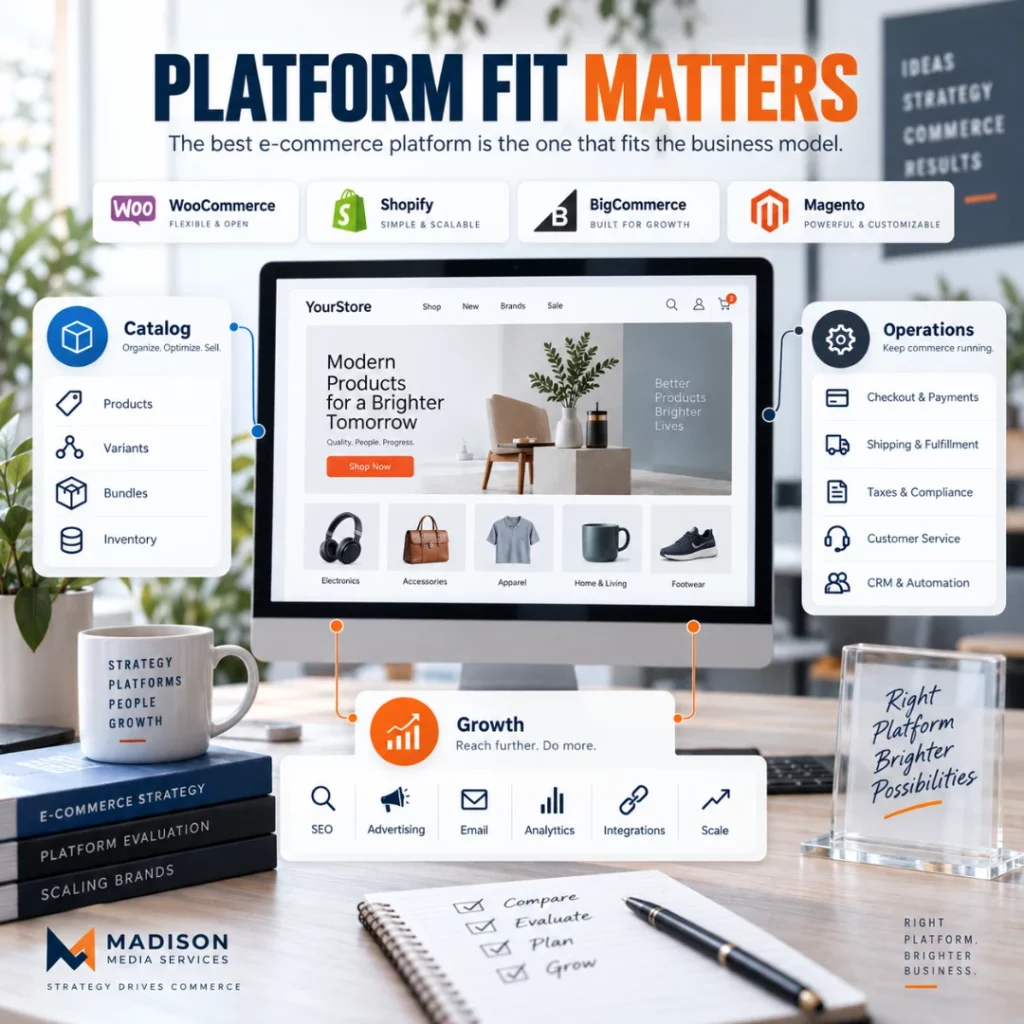
PLATFORM FIT MATTERS
The Best E-Commerce Platform Is the One That Fits the Business Model.
There is no universal platform that is automatically best for every online store. WooCommerce, Shopify, BigCommerce, Magento, and other commerce systems have different strengths, limitations, ecosystems, costs, and management requirements.
Therefore, platform selection should start with the business rather than a preferred logo. Catalog size, product types, subscriptions, shipping, inventory, integrations, internal staffing, customization needs, and future growth all influence the decision.
Catalog
Understand what you are selling.
Product count, variants, attributes, bundles, subscriptions, downloads, and inventory complexity can affect platform fit.
Operations
Understand what happens after checkout.
Payments, shipping, taxes, inventory, fulfillment, customer service, returns, and CRM workflows all affect the store architecture.
Growth
Plan for what the store may need next.
SEO, advertising, email, promotions, integrations, new product lines, marketplaces, and reporting needs can influence long-term platform decisions.
HOW E-COMMERCE PROJECTS WORK
From Store Strategy to Launch
A successful e-commerce project should begin with the business model, not the theme. First, we need to understand what is being sold, how customers buy, what systems are already in place, and what happens after the order is submitted.
Then the store can be planned around real customer and operational requirements.
01
Discover
Understand the business model before choosing the technology.
We review products, customers, catalog structure, fulfillment, current systems, marketing, inventory, payments, shipping, reporting, integrations, goals, and internal resources.
02
Plan
Define what the store needs to do.
Next, we establish platform requirements, page types, product architecture, checkout needs, account features, integrations, content, migration needs, and the most important customer actions.
03
Structure
Map the shopping journey before visual design begins.
Categories, navigation, product relationships, filters, search, supporting pages, cart behavior, calls to action, and internal links are organized around how customers should move through the store.
04
Design
Create an interface that supports browsing and buying.
The design phase establishes product presentation, hierarchy, typography, imagery, mobile behavior, cart interactions, checkout direction, brand elements, and reusable store components.
05
Develop
Turn the approved experience into a working store.
The store is developed on the selected platform with the product, checkout, account, content, integration, and custom functionality required by the approved scope.
06
Test
Review important customer and operational workflows.
Product pages, variants, cart behavior, payments, forms, mobile layouts, shipping logic, taxes, emails, integrations, and other critical functions are tested according to the project requirements.
07
Launch & Improve
Move from development into real store operations.
After launch, real customer behavior and business needs can guide future improvements, including SEO, advertising, email, maintenance, new integrations, landing pages, and conversion work.
WHAT A BETTER STORE SHOULD SUPPORT
What Should Better E-Commerce Development Actually Improve?
An e-commerce website cannot guarantee sales, conversion rate, revenue, rankings, or customer retention. Those outcomes depend on products, pricing, traffic, competition, demand, fulfillment, marketing, and many other factors.
Instead, strong development should improve the experience and systems the business can influence directly: product discovery, product clarity, mobile usability, checkout flow, integrations, and long-term store flexibility.
01
Product Discovery
Help customers reach relevant products faster.
Clear categories, navigation, filters, search, related products, and internal links can reduce the amount of work shoppers need to do before finding the right item.
02
Product Clarity
Give shoppers better information before checkout.
Useful product content, imagery, options, specifications, availability, policies, and supporting information can help customers make more confident buying decisions.
03
Mobile Shopping
Make store interactions practical on smaller screens.
Responsive layouts, touch-friendly controls, readable product information, simple cart actions, and mobile-aware checkout can improve the shopping experience across devices.
04
Operational Fit
Connect the storefront to the way the business actually works.
Appropriate integrations and workflows can reduce unnecessary manual steps between products, inventory, orders, CRM systems, fulfillment, and customer communication.
05
Scalability
Create a store that can support future growth.
A well-planned platform and architecture can make it easier to add products, categories, integrations, content, campaigns, marketplaces, and new customer experiences later.
REAL STORE. REAL WORK.
E-Commerce Proof Should Show the Shopping Experience and the Problem Solved.
A useful e-commerce case study explains more than how the finished homepage looks. It should show the business challenge, customer or operational problem, work completed, and a result that can be verified.
Before publishing, replace the placeholders below with an approved MMS e-commerce project and rights-cleared store imagery.

FEATURED E-COMMERCE PROJECT
Ravenscroft Escentials — Online Store Development
THE CHALLENGE
Ravenscroft Escentials needed an e-commerce experience capable of presenting a broad catalog of essential-oil products while making it easy for customers to browse, compare options, and purchase online.
The store needed to support multiple product categories, individual product variations, gift cards, customer accounts, search, shopping-cart functionality, and a clear path from product discovery through checkout. The business also needed the standard privacy and information-handling foundations expected from a modern e-commerce website.
WHAT WE BUILT
Madison Media Services developed the website’s e-commerce structure around the way Ravenscroft Escentials actually sells its products.
The project included:
- Organized product collections and category navigation
- Individual product pages with pricing and selectable options
- Shopping cart and checkout functionality
- Customer account/login access
- Gift-card purchasing
- Search functionality
- Mobile-friendly shopping
- Product inventory and availability information
- Contact and customer-support paths
- Newsletter and promotional opportunities
- Privacy-policy support and standard e-commerce information handling
- A flexible catalog structure that can accommodate additional products and collections over time
The site now gives customers a complete online path from discovering a product to adding it to their cart and completing an order.
THE VERIFIED OUTCOME
Ravenscroft Escentials operates a functioning online storefront where customers can browse a substantial catalog of essential-oil products, select product options, purchase gift cards, use a shopping cart, access customer accounts, and shop directly through the website.
The site also includes a published privacy policy covering information collected through activities such as account interactions, newsletter subscriptions, and online ordering, providing an important foundation for responsible customer-data handling.
PRODUCT DISCOVERY → PRODUCT OPTIONS → CART → CHECKOUT → ONLINE ORDERING
PLATFORM
WooCommerce
WORK INCLUDED
Strategy • Design • Development • Integrations
OUTCOME
PRODUCT DISCOVERY → PRODUCT OPTIONS → CART → CHECKOUT → ONLINE ORDERING
PLANNING AN ONLINE STORE
What Determines the Cost of an E-Commerce Website?
E-commerce website cost depends on much more than page count. Product complexity, platform requirements, checkout, payments, shipping, integrations, data migration, custom functionality, content, and testing can all change the project scope.
For example, a small store with a straightforward catalog requires a different development plan than a large operation connecting inventory, CRM, fulfillment, multiple payment rules, and custom customer workflows.
PROJECT FACTOR
MORE FOCUSED SCOPE
ADDS MORE SCOPE
Catalog Size & Product Complexity
A focused catalog has a manageable number of products, simple variants, and straightforward product data.
Large catalogs, complex variants, bundles, subscriptions, configurable products, downloads, or unusual product rules increase architecture and development work.
Platform Requirements
The business already has a suitable platform and straightforward technical requirements.
Platform migrations, replatforming, custom themes, legacy data, unusual extensions, or specialized infrastructure can add significant scope.
Checkout & Payments
A standard checkout uses commonly supported payment methods and a straightforward purchase flow.
Subscriptions, deposits, split payments, B2B pricing, quotes, complex tax rules, multiple currencies, or specialized checkout logic require more planning.
Shipping & Fulfillment
Products use simple shipping rules and a limited fulfillment workflow.
Carrier integrations, freight, local delivery, pickup, multiple warehouses, fulfillment partners, or complex rate logic add operational requirements.
Integrations
The store needs few third-party connections with documented APIs or supported extensions.
Inventory, ERP, CRM, POS, marketplace, fulfillment, accounting, or custom API connections increase development and testing needs.
Content & Product Data
Product information and imagery are accurate, organized, and ready for import or entry.
Large data cleanup, product writing, photography, image processing, taxonomy work, redirects, or migration mapping add production scope.
Custom Functionality
The project uses proven platform features and common store behavior.
Custom applications, unusual workflows, memberships, configurators, advanced search, personalization, or specialized customer portals require additional development.
COMMON E-COMMERCE QUESTIONS
Questions Businesses Ask Before Building an Online Store
E-commerce projects involve more than design. Platform choice, product data, payments, shipping, integrations, SEO, mobile use, migration, maintenance, and internal operations can all affect the finished store.
Which e-commerce platforms does Madison Media Services work with?
Madison Media Services currently identifies experience with WooCommerce, Shopify, BigCommerce, and Magento. The existing service page also references platform-specific development environments such as Shopify Liquid and BigCommerce Stencil.
However, platform choice should still be based on the store’s actual catalog, workflows, integrations, budget, internal resources, and long-term needs.
How do I know which e-commerce platform is right for my business?
Start with the business requirements rather than the platform brand. Product types, catalog size, inventory, shipping, subscriptions, checkout rules, integrations, customization, internal staffing, and future growth can all affect platform fit.
Therefore, discovery should happen before a final platform recommendation.
Can you redesign an existing online store?
Yes, an existing store can potentially be redesigned, rebuilt, or migrated. However, the current platform, URLs, products, customer data, orders, SEO visibility, integrations, payment setup, analytics, redirects, and operational workflows should be reviewed before changes begin.
A redesign is especially important to plan carefully when the store already receives meaningful organic traffic or processes active customer orders.
Can the store connect to our inventory system or CRM?
Potentially. The current MMS e-commerce page specifically references inventory-system and CRM connections, as well as custom applications and third-party integrations.
Whether a particular connection is practical depends on the systems involved, available APIs or extensions, data requirements, authentication, documentation, and the amount of custom development needed.
Will my e-commerce website work on mobile devices?
Responsive development is part of the current MMS e-commerce offering. Product browsing, navigation, filters, cart actions, forms, account areas, and checkout should be planned for smaller screens rather than treated as a desktop layout that simply shrinks.
In addition, mobile testing should cover the real buying workflow rather than only the homepage.
Will an e-commerce website automatically increase sales?
No. A website cannot guarantee sales, revenue, conversion rate, or profitability. Product demand, pricing, traffic, trust, competition, shipping, fulfillment, advertising, customer service, and many other factors affect commercial results.
Instead, development should improve the parts of the experience the website can control, such as product discovery, usability, product clarity, checkout flow, performance, and integrations.
Does e-commerce development include SEO?
Search-friendly architecture should be considered during the build. Product and category relationships, crawlable content, internal links, mobile usability, page performance, metadata opportunities, image context, and redirects can all affect search visibility.
However, ongoing competitive growth may require a dedicated SEO strategy after launch, especially for large catalogs or competitive product categories.
What happens after the online store launches?
After launch, the store enters real operations. Products change, customers behave differently than expected, integrations evolve, software updates, and new marketing opportunities appear.
As a result, businesses may need ongoing website maintenance, SEO, paid advertising, email marketing, new landing pages, marketplace expansion, reporting improvements, or additional development over time.
LET’S BUILD WHAT’S NEXT
Ready to Grow Your Business Online?
Let’s build a smarter digital strategy designed to increase your visibility, generate more leads, and help your business grow.