


CREATIVE AI • MADISON, WI
Creative AI Services for Madison, WI Businesses
Madison Media Services helps businesses evaluate and use creative AI tools for brand-consistent text, visuals, ideation, and production support without removing the strategy and human review that protect quality.
Because AI tools change quickly, the goal is not to chase every new platform. Instead, we help identify useful workflows, define brand inputs, create repeatable prompting systems, and review outputs before they become customer-facing content.
Madison-Focused Strategy
AI Text + Visual Workflows
Brand Consistency
Human Review
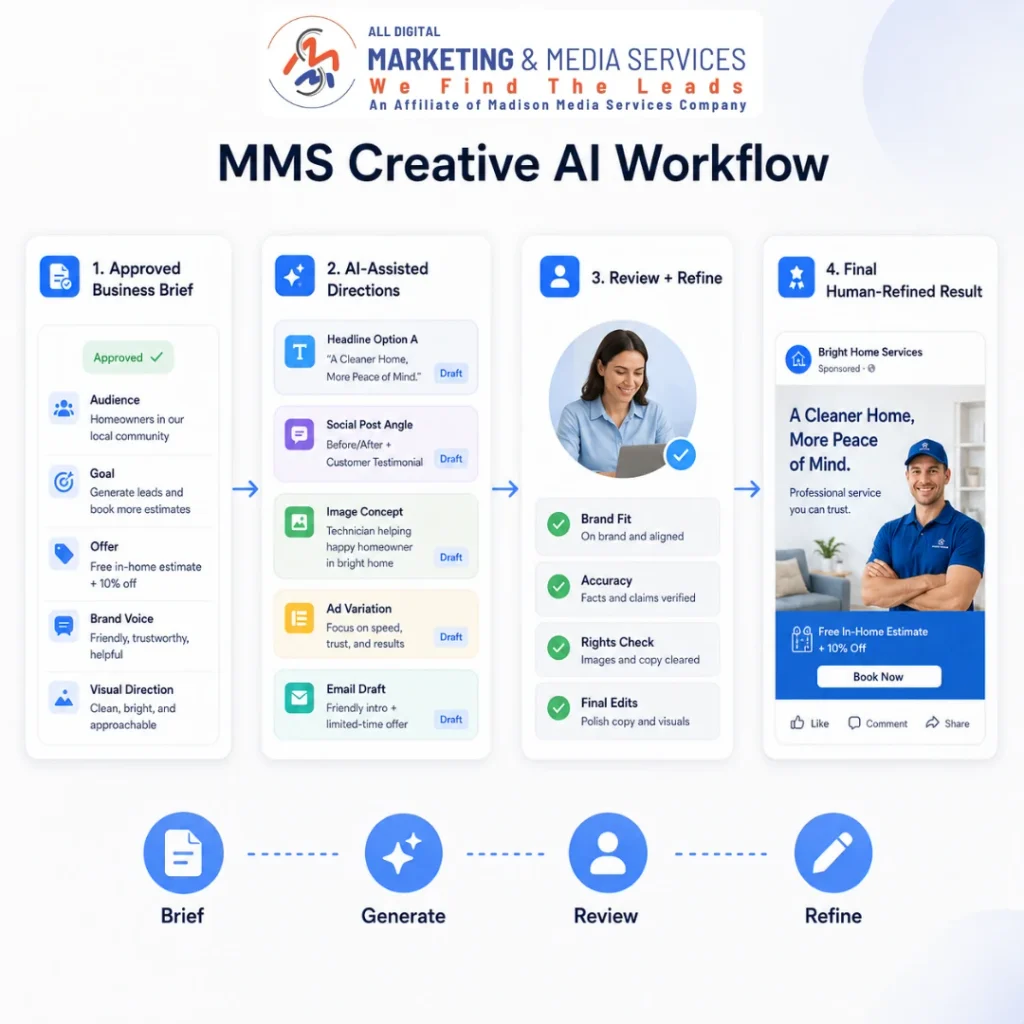
BRIEF + GENERATE + REVIEW + REFINE
Use AI to Accelerate Creative Work—Not Skip the Thinking
01
Brief
Start with audience, goal, offer, brand voice, and visual direction.
02
Create
Generate drafts, concepts, variations, and production starting points.
03
Review
Check accuracy, originality, brand fit, rights, and customer relevance before use.
TEXT + VISUALS
AI + HUMAN REVIEW
WHAT CREATIVE AI SERVICES INCLUDE
What Does Creative AI Actually Do for a Business?
Creative AI uses generative tools to assist with ideas, text, visuals, variations, and production tasks that normally require repeated manual drafting.
For example, a business can use AI to brainstorm campaign angles, create first-draft copy, explore visual directions, or repurpose an approved idea into additional formats. However, the final result still needs human review for accuracy, brand fit, originality, context, and appropriate use.
01
Creative Strategy
Define what the business needs to create, who it is for, and where AI can genuinely save production time.
02
Text Workflows
Use approved AI tools to support brainstorming, outlines, first drafts, variations, repurposing, and other text-based creative tasks.
03
Visual Workflows
Develop image concepts, art directions, variations, and visual assets where the selected tool and usage rights fit the project.
04
Brand & Review Systems
Create prompts, references, approval steps, and human checks that help outputs stay closer to the brand and business facts.
AI SHOULD REMOVE FRICTION, NOT STANDARDS
Producing More Content Is Not the Same as Producing Better Content.
Generative tools can produce a large amount of material quickly. Yet volume alone does not create a stronger brand, useful campaign, or trustworthy customer experience.
Instead, Creative AI should reduce repetitive production work while preserving the strategy behind the asset. More importantly, the business still needs to decide what should be said, what should be shown, and what is ready to publish.
MOVE FASTER. KEEP THE STANDARD.
01
Creative Work Takes Time
Strong marketing often requires more versions than a small team can comfortably produce.
A campaign may need headlines, social variations, visual concepts, emails, landing-page ideas, or supporting graphics. Therefore, AI can be useful when it speeds up controlled iteration.
02
Blank-Page Work Slows Teams Down
Starting from nothing creates unnecessary production friction.
Instead, AI can provide a structured first draft or idea set. Then a strategist, writer, designer, or business owner can evaluate what deserves further development.
03
Inconsistent Inputs Create Inconsistent Outputs
A generic prompt rarely produces reliable brand work.
Because AI responds to the context it receives, brand voice, audience, offer, examples, facts, visual references, and constraints should be defined before expecting consistent results.
04
Fast Content Can Still Be Wrong
Speed is not useful when the output is inaccurate, generic, or risky.
Consequently, every customer-facing asset should be reviewed for factual accuracy, misleading claims, copyright concerns, visual mistakes, privacy issues, and whether it actually sounds like the business.
CREATIVE AI CAPABILITIES
The Tool Matters Less Than the Workflow Around It.
The current MMS partnership positioning emphasizes vetted AI tools that can generate brand-consistent text and visuals. That is the right starting point, but a tool alone does not know the business, customer, offer, approval process, or quality standard.
Therefore, the redesigned service focuses on how the technology is selected, instructed, reviewed, and connected to real marketing work.
01
AI Tool Evaluation
Choose tools around the creative task instead of chasing every new launch.
MMS positions Creative AI around vetted tools for text and visual generation. Because platforms evolve rapidly, recommendations should be based on current capabilities, workflow fit, cost, data handling, and output quality.
02
Prompt & Brief Development
Give the model enough useful direction to create a better starting point.
Audience, business facts, offer, brand voice, format, examples, required elements, prohibited claims, and visual direction can all shape the prompt. As a result, outputs become easier to evaluate and refine.
03
AI-Assisted Copy Development
Use generation for ideation and drafting while keeping editorial control.
Creative AI can support headlines, concepts, outlines, social drafts, email variations, ad ideas, website starting points, and content repurposing. However, final copy should be fact-checked, edited, and aligned with the actual marketing goal.
04
AI-Assisted Visual Creation
Explore visual concepts and production options without treating every generated image as finished artwork.
Selected tools can support concept development, image generation, background ideas, composition exploration, and visual variations. Meanwhile, human review should catch anatomy, text, branding, product, logo, and context errors before publication.
05
Brand Consistency Systems
Create reusable inputs that make future AI work less random.
Approved brand language, style references, examples, visual rules, prompt templates, and do-not-use guidance can help teams create more consistent outputs. Therefore, each new task does not have to start from zero.
06
Creative Workflow Integration
Fit AI into existing marketing rather than creating a separate content universe.
Generated drafts can support social media, email, paid ads, website projects, branding, and other MMS services. Consequently, AI becomes one production layer inside a broader strategy instead of an isolated novelty.
AI
+ REVIEW
AI-ASSISTED DOES NOT MEAN AI-UNSUPERVISED
The Strongest Creative AI Workflow Has a Human Decision at the End.
For Madison businesses, brand reputation matters more than producing another generic post or image. AI can accelerate brainstorming and production, but it can also produce false details, awkward wording, visual errors, or content that does not match the company.
For that reason, the final approval should remain with a person who understands the business and campaign goal. The useful part of AI is speed and iteration; the useful part of human review is judgment.
First Draft
Let AI accelerate the starting point.
A strategist can use AI to generate options, outlines, visual ideas, or alternate directions. Then the strongest material moves into human editing and design.
Brand Check
Compare the output against approved business standards.
Voice, terminology, colors, imagery, claims, audience, tone, and prohibited content should be reviewed before an asset moves forward.
Final Production
Use the approved direction in the channel where it belongs.
After review, the asset can be adapted for social, email, advertising, websites, presentations, or other customer-facing materials as appropriate.
HOW CREATIVE AI IMPLEMENTATION WORKS
From Creative Bottleneck to Repeatable AI-Assisted Workflow
A useful AI project begins with a specific production problem, not with the question, “How can we use AI?” First, the business should identify what takes too long, where quality breaks down, and which tasks still require human judgment.
Then the tools, brand inputs, prompts, and review process can be designed around that real need.
01
Define the Use Case
Decide which creative bottleneck AI is supposed to improve.
First, we identify the real task: brainstorming, copy drafts, visual concepts, variations, repurposing, recurring production, or another specific workflow. Clear use cases prevent the project from becoming a vague AI experiment.
02
Choose the Tool
Match the use case to a current platform with appropriate capabilities.
Next, tools are compared for output type, quality, workflow, pricing, integrations, privacy considerations, commercial-use terms, and practical fit. Because platforms change quickly, current terms should be verified before adoption.
03
Build the Brand Inputs
Give the workflow reliable context about the business.
Approved voice, service facts, audience, differentiators, examples, visual references, colors, terminology, claims, and restrictions are organized. As a result, prompts can begin with stronger information.
04
Create Prompt Systems
Turn useful instructions into repeatable templates.
Prompts are structured around the goal, format, audience, source facts, style, constraints, and expected output. In addition, templates can reduce the amount of reinvention required for recurring tasks.
05
Generate & Curate
Produce options and select what is worth developing.
AI can create several directions quickly. However, the team should reject weak, repetitive, inaccurate, or off-brand outputs instead of polishing everything the tool produces.
06
Review & Refine
Apply human editing, design judgment, fact-checking, and rights review.
Selected drafts are checked for accuracy, tone, visual defects, unsupported claims, privacy, copyright concerns, and platform requirements. Meanwhile, the strongest pieces are refined into publishable assets.
07
Document & Improve
Save what worked so the next project starts smarter.
Finally, effective prompts, references, approved outputs, common failure modes, and team feedback can be documented. Consequently, the workflow becomes more consistent over time.
WHAT CREATIVE AI SHOULD IMPROVE
What Should Creative AI Actually Improve for a Business?
Creative AI cannot guarantee better marketing performance, lower costs, perfect brand consistency, originality, conversions, rankings, or faster production in every situation. Results depend on the task, model, inputs, review process, team skill, and final execution.
Instead, a well-designed workflow should improve the parts the business can control directly: ideation speed, production efficiency, variation, reusable brand inputs, review consistency, and the ability to turn approved ideas into more usable assets.
01
Faster Ideation
Generate more starting points without treating every idea as finished work.
AI can help teams get past the blank page and compare several directions quickly. Therefore, more time can be spent evaluating and improving the strongest options.
02
Production Efficiency
Reduce repetitive drafting and variation work where automation fits.
Recurring formats, repurposing, alternate headlines, image concepts, and structured first drafts can move faster. However, efficiency depends on having useful templates and review steps.
03
Brand Consistency
Give AI clearer rules for voice, imagery, terminology, and claims.
Reusable brand inputs and prompt templates can reduce randomness across repeated tasks. In addition, human approval protects the identity when the model produces something that does not fit.
04
Creative Range
Explore more directions before committing production resources.
Text and visual generation can help teams test ideas that might otherwise take too long to mock up. As a result, creative decisions can begin with more options.
05
Reusable Knowledge
Turn successful prompts and examples into a working internal system.
Documented inputs, templates, examples, and quality checks can help employees repeat useful workflows instead of rediscovering the same process every time.
PLANNING CREATIVE AI FOR YOUR BUSINESS
What Determines the Cost of Creative AI Services in Madison, WI?
Creative AI service cost depends on the use case, tools, brand setup, prompt development, number of output types, review requirements, workflow integrations, training, and whether MMS is building the system or also producing recurring assets.
For example, a Madison company that needs a repeatable social-caption workflow has a different scope than a business building text and visual systems for several brands, campaigns, audiences, and internal teams.
PROJECT FACTOR
MORE FOCUSED SCOPE
ADDS MORE SCOPE
Use Case
The business has one clear creative task and a defined audience or channel.
Several teams, content types, campaigns, departments, or use cases require more workflow design and documentation.
Brand Inputs
Approved messaging, visual identity, examples, and business facts already exist.
Missing or inconsistent brand guidance requires additional discovery, writing, design direction, and approval before reliable prompting can begin.
Output Type
The workflow focuses on one main format such as text drafts or visual concepts.
Multiple asset types, complex compositions, long-form content, specialized production, or cross-channel variations increase review and refinement work.
Prompt System
A focused template can handle a recurring task with limited variables.
Conditional prompts, several audience types, multiple services, dynamic inputs, or complex structured outputs require deeper prompt design and testing.
Human Review
One knowledgeable reviewer can approve brand and factual accuracy.
Several stakeholders, regulated topics, legal review, medical or financial claims, sensitive customer data, or strict compliance requirements add review layers.
Tool Stack
The project uses a small number of established tools with straightforward workflows.
Several AI platforms, integrations, custom automation, team access, asset libraries, or data connections can expand technical scope.
Ongoing Production
The engagement focuses on setup, templates, and a defined creative workflow.
Recurring asset production, prompt optimization, content calendars, campaign support, visual refinement, or continuous tool evaluation adds ongoing service scope.
COMMON CREATIVE AI QUESTIONS
Questions Madison Businesses Ask About Creative AI
Creative AI raises practical questions about quality, branding, ownership, SEO, human review, and which tasks should actually be automated. These answers clarify how MMS approaches AI as a production tool inside a larger creative process.
Capabilities, Text & Visual Workflows
What is Creative AI?
Creative AI refers to generative tools used to assist with creative work such as brainstorming, text drafting, visual generation, variations, repurposing, and other production tasks.
At MMS, the public partnership positioning centers on vetted tools for brand-consistent text and visuals rather than treating AI as a replacement for marketing strategy.
Can Creative AI write marketing content for our business?
Yes, AI can support ideas, outlines, first drafts, variations, repurposing, captions, headlines, email concepts, and other text-based work.
However, customer-facing content should still be reviewed and edited for accuracy, brand voice, originality, claims, and whether it actually serves the campaign goal.
Can Creative AI generate images for our brand?
Yes, selected generative tools can create visual concepts and images when the project, platform, and usage terms are appropriate.
Before publishing, the output should be checked for visual defects, inaccurate product details, incorrect text, brand mismatches, inappropriate similarities, and other issues that require human judgment.
How do you keep AI-generated work consistent with our brand?
Consistency starts with better inputs. Approved brand voice, messaging, services, audience, visual references, colors, examples, terminology, and prohibited claims can all become part of the prompt and review system.
In addition, reusable templates and human approval help prevent each generation from becoming a completely different interpretation of the brand.
Human Review, SEO & Responsible Use
Does Creative AI replace a copywriter, designer, or marketing team?
Not automatically. AI can accelerate drafts, variations, brainstorming, and certain production tasks, but people still provide strategy, judgment, editing, art direction, business context, and approval.
Therefore, the strongest workflow uses AI where it saves time while keeping skilled human review where quality and context matter.
Can AI-generated content be used for SEO?
AI can assist with research organization, outlines, drafts, summaries, repurposing, and other content tasks, but publishing large amounts of generic or unreviewed material is not a sound SEO strategy.
Instead, search content should provide useful information, accurate business facts, clear expertise, original value, and human review regardless of which tools helped produce the first draft.
Are there copyright or ownership concerns with AI-generated creative?
Potentially. Terms, training data, output rights, similarity risks, trademarks, copyrighted characters, logos, and commercial-use rules can vary by tool and jurisdiction.
For that reason, businesses should review current platform terms and obtain appropriate legal advice when a project has significant intellectual-property risk. MMS should not present AI generation as a guarantee of exclusive ownership.
Do you provide Creative AI services specifically for Madison businesses?
Yes. Madison Media Services is based in Madison, Wisconsin and positions Creative AI as part of its broader digital, marketing, branding, and technology partnership services.
Because the workflow starts with the individual business, Madison companies can define their own brand voice, services, audience, creative needs, review rules, and production goals.
LET’S BUILD WHAT’S NEXT
Ready to Grow Your Business Online?
Let’s build a smarter digital strategy designed to increase your visibility, generate more leads, and help your business grow.