


REPUTATION MANAGEMENT • WISCONSIN
Reputation Management for Wisconsin Businesses
Madison Media Services helps businesses create a more consistent process for monitoring reviews, managing business information, planning customer responses, and understanding how their online reputation appears across important platforms.
Because reputation affects customer confidence before a call, form submission, visit, or purchase, the goal is not to manufacture a perfect rating. Instead, we help businesses manage genuine feedback and public information with a practical, policy-aware approach.
Serving Since 2008
Review Monitoring
Listing Accuracy
Wisconsin-Based Team
MONITOR + RESPOND + CORRECT
A Clearer Process for Your Online Reputation
01
Review Visibility
First, create a process for seeing important customer feedback across the supported review channels.
02
Response Workflow
Next, define a more consistent approach to brand voice, approvals, privacy, escalation, and responses.
03
Listing Accuracy
Finally, identify inaccurate business information and other listing issues across supported platforms.
REVIEWS + LISTINGS
TRUST + CONSISTENCY
WHAT REPUTATION MANAGEMENT INCLUDES
What Does Business Reputation Management Actually Do?
Business reputation management creates a repeatable process for seeing customer feedback, responding appropriately, correcting inaccurate public information, and evaluating patterns that may affect customer trust.
In addition, reputation work can support local marketing by keeping important business information more consistent. However, platforms control their own review, listing, and moderation decisions, so no agency can guarantee ratings, removals, or placement.
01
Review Monitoring
Track customer feedback across supported review channels so important comments are less likely to be missed.
02
Response Planning
Create practical response guidance around brand voice, approvals, privacy, escalation, and sensitive situations.
03
Business Listing Updates
Identify inaccurate names, addresses, phone numbers, hours, categories, duplicates, and other listing issues within the supported network.
04
Feedback & Reporting
Use compliant feedback processes where appropriate and review trends, listing status, response coverage, and other useful reputation indicators.
WHAT BETTER REPUTATION MANAGEMENT SHOULD SUPPORT
What Should a Reputation Management Program Actually Improve?
Reputation management cannot guarantee more five-star reviews, higher rankings, review removals, or a specific sales result. Instead, it should improve the business’s ability to monitor, respond, correct, and learn.
01
Awareness
See reputation issues sooner.
A defined monitoring process can help the business identify reviews, listing problems, and profile changes sooner. Consequently, fewer important issues depend on someone remembering to check manually.
02
Consistency
Create a more dependable public response process.
Clear brand voice, approvals, escalation, and posting responsibilities make responses more consistent. In addition, multiple locations can follow the same core standards while allowing appropriate local context.
03
Accuracy
Reduce customer confusion caused by incorrect information.
More consistent names, phone numbers, addresses, hours, and other listing details can make it easier for customers to contact or visit the business. However, platforms still control final display and update timing.
04
Trust
Give customers clearer evidence of an active business.
Thoughtful responses and accurate profiles can show that a business pays attention to customer feedback. Still, reputation management should never promise a particular rating or customer decision.
05
Insight
Turn public feedback into useful business information.
Review themes can reveal recurring strengths, questions, or concerns. As a result, the business may discover issues that can improve customer communication, operations, or service delivery.
WHAT THE WORK CAN INCLUDE
Reputation Management Connects Reviews, Listings, Responses & Reporting
The exact platform list, monitoring frequency, response responsibilities, reporting cadence, and plan limits should be defined in the project scope. Even so, the core reputation-management system generally revolves around a consistent set of activities.
01
Review Monitoring
Create visibility across supported review channels.
We help establish a process for seeing important customer feedback and determining who should be alerted. In addition, the workflow can account for multiple locations when the service scope supports them.
02
Response Guidance & Workflow
Help the business respond with consistency.
Response planning can define brand voice, approval steps, privacy limits, sensitive-topic escalation, and who is responsible for posting. As a result, replies can feel more deliberate and less reactive.
03
Business Listing Management
Improve the accuracy of public business information.
Listing work can address supported directories, duplicates, location details, phone numbers, hours, categories, and other public information. However, platforms control update timing and final display.
04
Google Review Support
Support genuine customer-feedback processes.
Where permitted, a reputation strategy can make it easier for customers to share honest feedback. Therefore, requests should remain neutral and should not use incentives, review gating, pressure, or requests for only positive sentiment.
05
Policy Issue & Review Dispute Guidance
Handle questionable reviews with realistic expectations.
Some reviews may violate a platform’s policies and may be eligible for reporting. Nevertheless, the platform decides whether content is removed, and no removal outcome should be guaranteed.
06
Reputation Reporting & Multi-Location Oversight
Turn activity into a clearer operating picture.
Reporting can track supported listings, review activity, response coverage, policy actions, and location-level patterns. Consequently, businesses can see where their reputation process is working and where attention is still needed.
YOUR REPUTATION IS MORE THAN A STAR RATING
A Strong Reputation Process Starts With Consistency.
Potential customers can encounter reviews, map listings, business profiles, directory information, and brand responses before they ever reach your website.
Because those touchpoints are public, reputation management should focus on accurate information and genuine customer experiences rather than shortcuts designed to manufacture praise.
MONITOR. RESPOND. CORRECT. LEARN.
01
See the Conversation
Know where customer feedback is appearing.
When reviews are spread across multiple profiles and locations, businesses can miss important feedback. Therefore, monitoring creates a clearer view of what customers are saying.
02
Respond Consistently
Create a repeatable response process.
A fast response is not always the same as a good response. Instead, brand voice, privacy, approvals, escalation, and the nature of the review should guide how the business replies.
03
Correct Public Information
Reduce avoidable listing confusion.
Incorrect hours, outdated phone numbers, duplicate listings, and inconsistent business details can frustrate customers. As a result, listing accuracy is an important part of reputation management.
04
Learn from Patterns
Use feedback as business information.
Reviews can reveal recurring questions, service concerns, praise, or location-specific issues. Consequently, reputation reporting can help the business identify patterns that deserve attention.
Pricing
Reputation Management Plans
Silver
$79 / month
Get startedA simple reputation plan for businesses that want a stronger online presence.
- Review monitoring
- New review awareness
- Bad Review Control
- Stronger first impressions
- Better consistency
Includes AI auto reply
Gold
$129 / month
Get startedEverything in the Silver plan, plus:
- AI auto reply
- Faster engagement
- More consistency across responses
- Stronger customer confidence
TRUST
EARNS
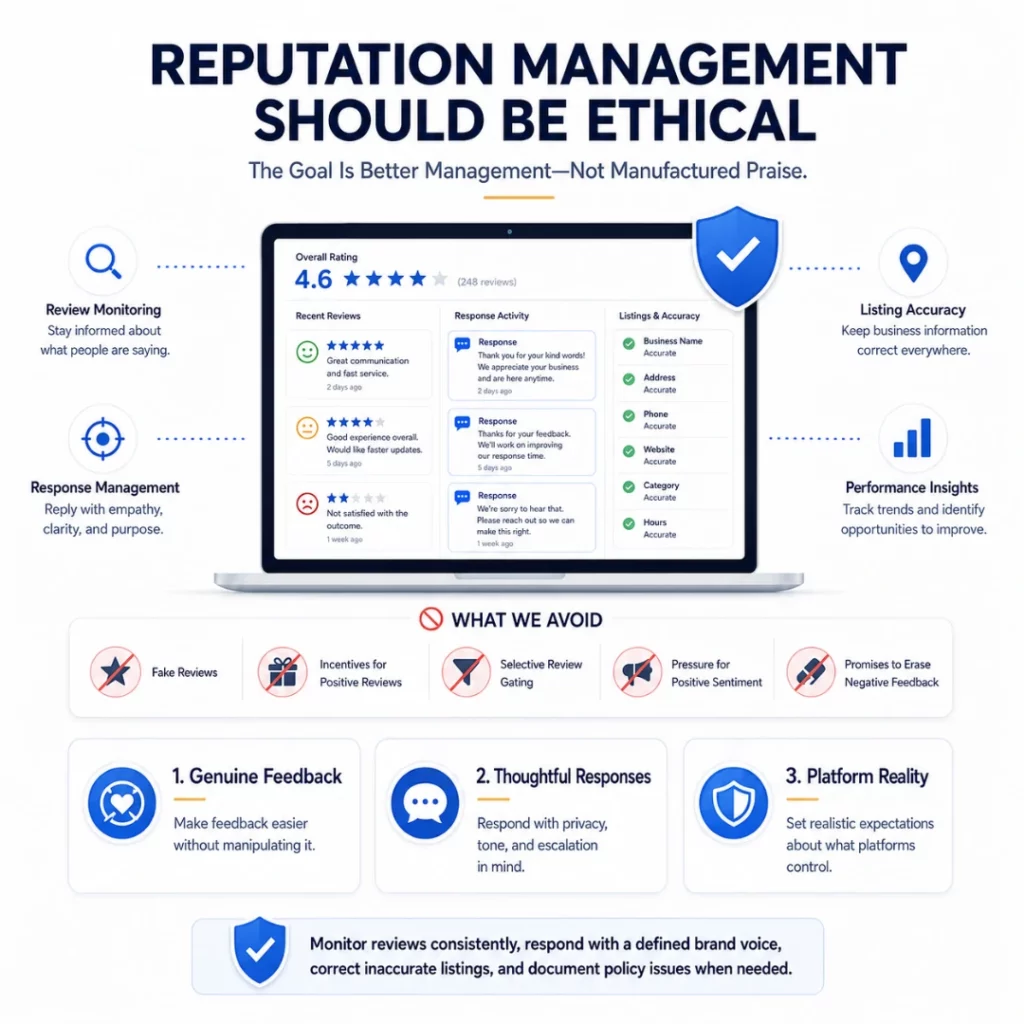
REPUTATION MANAGEMENT SHOULD BE ETHICAL
The Goal Is Better Management—Not Manufactured Praise.
Customers should be free to share genuine experiences. Therefore, a reputation strategy should not depend on fake reviews, incentives, selective review gating, pressure for positive sentiment, or promises that negative feedback can simply be erased.
Instead, the business can improve the process around feedback. For example, it can monitor reviews more consistently, respond with a defined brand voice, correct inaccurate listings, and document policy issues when they arise.
Genuine Feedback
Make feedback easier without manipulating it.
Where platform rules allow requests, the process should seek honest customer feedback rather than a specific star rating.
Thoughtful Responses
Respond without creating new problems.
Privacy, sensitive topics, escalation rules, approvals, and the business’s tone should guide how public responses are handled.
Platform Reality
Know what the business can and cannot control.
Platforms ultimately control review moderation, listing updates, display behavior, and removal decisions. As a result, reputation management should set realistic expectations.
HOW REPUTATION MANAGEMENT WORKS
From Reputation Audit to Ongoing Management
A useful reputation program needs clear permissions, responsibilities, platform rules, and escalation steps. Therefore, the process should be defined before the business begins responding or changing listings at scale.
01
Assess
Understand the current reputation footprint.
First, review the business’s locations, important profiles, known listing issues, review activity, response habits, existing tools, account access, and the problems the business most wants to solve.
02
Define
Set the platforms, permissions, and responsibilities.
Next, define which profiles are in scope, who owns access, who receives alerts, who approves responses, what the agency handles, and what still belongs to the client.
03
Monitor
Create visibility around incoming feedback and listing changes.
Then, use the agreed workflow to watch supported channels. As a result, the right people can see reviews, listing problems, duplicates, and other reputation issues that need attention.
04
Respond
Use brand voice, approval, privacy, and escalation rules.
For routine feedback, the process can support timely and consistent responses. However, sensitive customer, legal, employment, medical, financial, or other private matters may require escalation instead of a detailed public reply.
05
Correct
Work through supported listing and profile issues.
In addition, inaccurate business details and duplicate listings can be identified and submitted for correction where the platform permits. Platform review and processing times may vary.
06
Encourage Feedback
Use neutral, policy-aware customer feedback workflows.
Where appropriate, customers can be given a straightforward way to share genuine feedback. Nevertheless, the workflow should avoid incentives, selective gating, or requests that pressure customers toward positive reviews.
07
Report & Improve
Review trends and decide what needs attention next.
Finally, reporting can summarize activity, response coverage, listing status, unresolved issues, and recurring feedback. That information helps the business improve both its reputation process and, where relevant, the customer experience itself.
REAL REPUTATION WORK. REAL CONTEXT.
Show the Process, Not a Fabricated Five-Star Story.
A useful reputation case study should explain the starting problem, the management process, and a verifiable improvement without implying that every business will receive the same result.
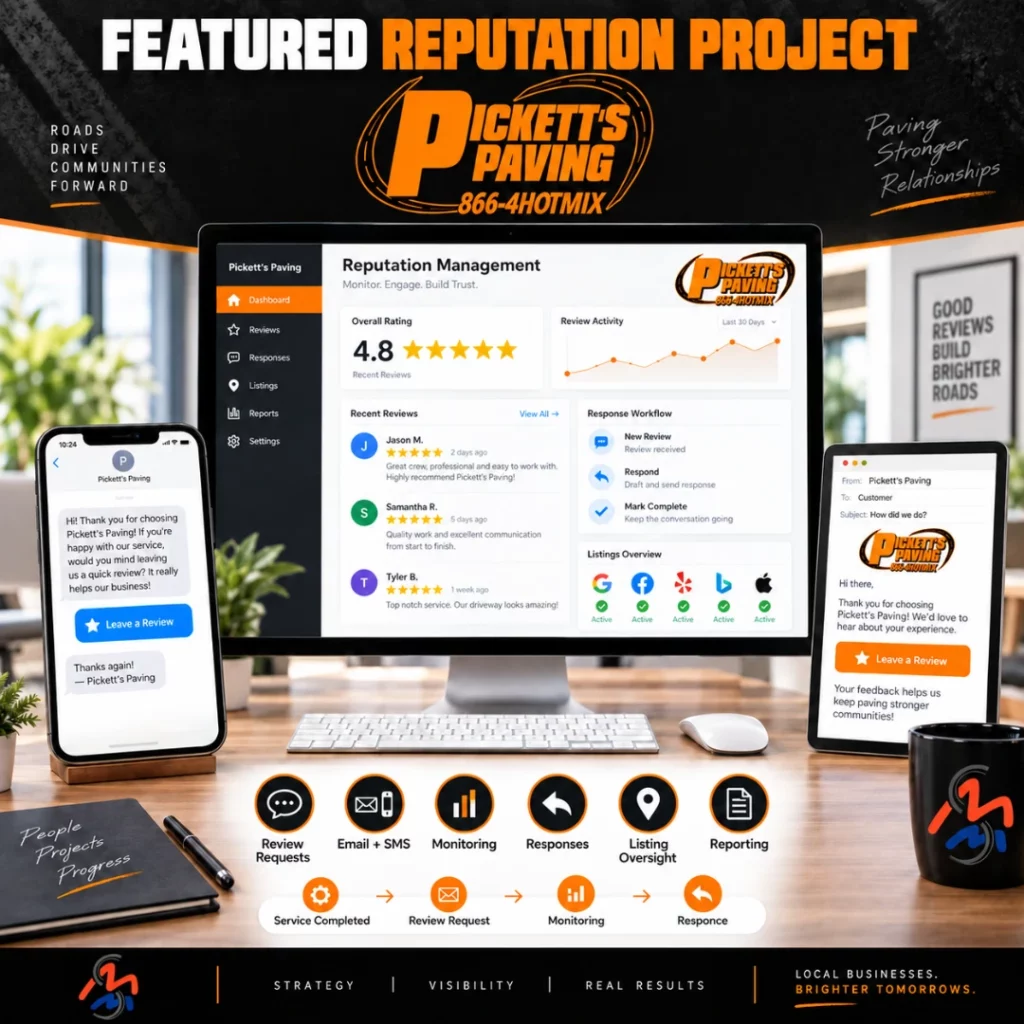
FEATURED REPUTATION PROJECT
Pickett’s Paving — Automated Review & Reputation Management
THE CHALLENGE
Pickett’s Paving needed a more consistent way to follow up with customers after completed services and manage its online reputation without relying on manual review requests.
The goal was to make it easier for customers to share genuine feedback, while giving the business a clearer process for monitoring reviews, responding appropriately, and keeping its online presence organized.
WHAT WE CHANGED
Madison Media Services implemented an automated post-service reputation workflow for Pickett’s Paving.
After a completed service, the system can send the customer an email and SMS review request with a direct link to leave feedback. From there, MMS provides ongoing reputation-management support, including:
- Automated email and SMS review-request workflows
- Review monitoring across relevant platforms
- Review-response management and brand-voice consistency
- Escalation of sensitive or negative feedback when appropriate
- Business listing and profile oversight
- Identification of inaccurate or inconsistent information
- Reputation reporting and ongoing account organization
- Support with platform or policy-related issues when they arise
The process is designed to encourage honest customer feedback, not a specific rating or manufactured positive reviews.
THE VERIFIED RESULT
Pickett’s Paving now has a structured reputation-management process that connects the customer experience after service with ongoing review monitoring and response management.
Instead of depending on occasional manual follow-up, the business has a repeatable system for requesting feedback, monitoring new reviews, managing responses, and maintaining better oversight of its online reputation.
SERVICE COMPLETED → EMAIL + SMS REVIEW REQUEST → MONITORING → RESPONSE + REPUTATION OVERSIGHT
BUSINESS TYPE
Local Paving Company • Multi-Location
WORK INCLUDED
Monitoring • Responses • Listings • Reporting
MEASURED OUTCOME
SERVICE COMPLETED → EMAIL + SMS REVIEW REQUEST → MONITORING → RESPONSE + REPUTATION OVERSIGHT
PLANNING A REPUTATION PROGRAM
What Determines the Scope and Cost of Reputation Management?
Reputation management can range from a focused review-and-listing workflow to a more involved multi-location program. Therefore, pricing depends on the number of profiles, locations, workflows, corrections, approvals, and reporting requirements involved.
Exact platform coverage, response responsibilities, reporting cadence, contract terms, and plan limits should be confirmed in the proposal rather than assumed from a generic package name.
REPUTATION FACTOR
MORE FOCUSED SCOPE
ADDS MORE SCOPE
Number of Locations
One business location with a small set of priority profiles.
Multiple offices, franchises, departments, practitioners, or service areas add permissions, routing, listings, review volume, and reporting complexity.
Platforms & Profiles
A focused set of major profiles is already claimed and accessible.
Many directories, legacy profiles, duplicates, missing credentials, practitioner listings, or unsupported profiles require more discovery and cleanup.
Review Activity
Review volume is manageable and the business already responds consistently.
High review volume, missed reviews, multiple response owners, sensitive topics, or inconsistent historical responses require a more structured workflow.
Listing Condition
Business information is mostly accurate and only occasional corrections are needed.
Incorrect hours, old phone numbers, duplicate locations, moves, rebrands, ownership changes, or inconsistent categories can add substantial listing work.
Response Workflow
One decision-maker can approve routine responses quickly.
Multiple approvers, regulated industries, legal review, privacy concerns, escalation rules, or location-specific teams increase response-management complexity.
Feedback Process
The business already has a compliant way to invite genuine customer feedback.
New feedback workflows, staff training, multiple customer touchpoints, platform-specific rules, or legacy incentive/gating practices require additional planning.
Reporting & Oversight
A straightforward monthly summary meets the business’s needs.
Multi-location comparisons, management dashboards, issue tracking, executive reporting, custom KPIs, or integrations can add scope.
COMMON REPUTATION QUESTIONS
Questions Businesses Ask About Reviews & Reputation Management
Reputation management involves platforms the business does not control. Therefore, the most important questions usually involve review requests, responses, removals, listings, multi-location management, and realistic expectations.
Can reputation management remove a negative Google review?
Sometimes a review may violate a platform’s content policies and may be eligible for reporting. However, the platform—not Madison Media Services—decides whether the review is removed.
Therefore, we do not promise deletion or suppression. A practical process focuses on documenting potential policy issues, following the available reporting process, and responding appropriately when removal does not occur.
Can you guarantee more five-star reviews?
No. Genuine customer feedback should not be manipulated or guaranteed. In addition, review incentives, selective review gating, pressure for positive sentiment, and fake reviews can create policy and trust problems.
Where review requests are appropriate, the better approach is to make it easier for customers to share honest feedback without telling them what rating to leave.
Does reputation management include responding to reviews?
Response support can be part of a reputation-management program, but the exact responsibility should be defined in the service scope.
For example, a workflow may include drafting guidance, brand-voice standards, approval steps, escalation rules, or posting responsibilities. Sensitive matters may require direct client review before anything is published.
What is business listing management?
Business listing management focuses on public information such as business names, addresses, phone numbers, hours, categories, and location details across supported platforms.
However, each platform controls its own data and update process. Therefore, an agency can submit or manage supported changes but cannot promise that every directory will display information identically or update immediately.
How does reputation management help a local business?
Local customers often see reviews and business profiles while deciding whom to contact. As a result, accurate listings, consistent responses, genuine feedback, and active profile management can support customer trust.
Reputation can also complement local SEO. Nevertheless, no specific Google ranking or map position can be guaranteed.
Can you help businesses with multiple locations?
Multi-location reputation management can create shared standards for listings, review monitoring, responses, permissions, and reporting while still allowing appropriate local context.
Because the workload changes with location count, profile count, review volume, and internal approvals, the exact multi-location scope should be defined before launch.
What should a business do with an unfair review?
First, separate an unpleasant review from a review that may actually violate platform policy. A critical opinion is not automatically removable.
Next, document the issue and avoid posting private customer details in a public reply. If a policy violation appears possible, the review can be reported through the platform’s process. Meanwhile, a calm public response may still be appropriate.
How do you measure reputation management?
Useful measurements depend on the agreed scope. For example, reporting may include review activity, response coverage, unresolved reviews, listing accuracy, duplicate issues, profile changes, policy reports, and location-level trends.
Ultimately, the goal is a better-managed reputation process. Therefore, one star-rating number should not be the only KPI.