


PAID ADS MANAGEMENT • WISCONSIN
Paid Ads Management in Wisconsin Built Around Measurable Growth
Madison Media Services helps businesses build, manage, test, and refine paid advertising campaigns around clearer goals, stronger landing experiences, and better measurement.
Ad spend alone does not create results. Instead, successful paid campaigns depend on audience targeting, offer strength, message clarity, landing pages, conversion tracking, budget control, testing, and ongoing optimization. Therefore, our process connects campaign management to the parts of the customer journey that influence real performance.
Serving Since 2008
Campaign Setup + Management
Testing + Optimization
Tracking + Reporting
GOALS + TESTING + MEASUREMENT
Paid Campaigns Need More Than a Budget
01
Targeting
First, campaigns need targeting based on audience, intent, location, and the type of opportunity the business wants to attract.
02
Offer + Landing Page
Next, the ad and landing page should work together so the message, offer, and next step feel connected rather than fragmented.
03
Measurement
Finally, tracking, testing, and reporting help show what is happening so the campaign can be refined over time.
PAID SEARCH + PPC
TEST + IMPROVE
WHAT PAID ADS MANAGEMENT INCLUDES
What Does a Paid Ads Agency Actually Manage?
Paid ads management combines campaign planning, audience research, ad creation, targeting, conversion tracking, monitoring, testing, and ongoing optimization.
However, the exact work should depend on the platform and business goal. Google Search, YouTube, Meta, LinkedIn, and other paid channels do not use identical targeting, billing, creative, or optimization models.
01
Campaign Planning
Define the audience, location, offer, objective, budget, conversion actions, platform, and campaign structure before launch.
02
Ad & Creative Testing
Test headlines, descriptions, calls to action, images, and other eligible assets so campaign decisions are based on real response data.
03
Conversion Tracking
Identify meaningful actions such as calls, forms, bookings, purchases, or qualified lead stages so optimization is not based on traffic alone.
04
Monitoring & Optimization
Review campaign performance, search terms, targeting, budgets, creative, bids, lead quality, and landing-page behavior to guide the next change.
CLICKS ARE NOT THE BUSINESS GOAL
Ad Spend Without Clear Measurement Is Hard to Improve.
A campaign can generate impressions and clicks while still leaving the business unsure what happened next. In addition, poor targeting, unclear conversion tracking, weak landing pages, or slow follow-up can make useful advertising data difficult to interpret.
Therefore, we focus on connecting campaign activity to the actions the business actually values.
SPEND WITH A PURPOSE.
01
Target the Right Opportunity
Match the platform to the customer journey.
Search, paid social, video, and professional-network campaigns behave differently. As a result, audience strategy should reflect the platform and objective rather than forcing every campaign into one model.
02
Measure Real Actions
Track what happens after the click.
For example, calls, completed forms, scheduled consultations, purchases, qualified-lead stages, and signed clients can provide better context than page views or button clicks alone.
03
Test Before Scaling
Use live data before adding complexity.
A focused campaign can produce clearer early learning. Then, once the data supports it, the account can expand into additional keywords, audiences, creative, locations, or platforms.
04
Keep the Business Informed
Make campaign decisions easier to understand.
Finally, reporting should explain what changed, which actions matter, what the data suggests, and what should be tested next instead of relying on a dashboard with little context.
WHAT WE MANAGE
Paid Advertising Works Best as a Managed System.
A campaign needs more than ads. It also needs a clear offer, sensible targeting, usable landing pages, reliable tracking, regular review, and a process for turning new information into better decisions.
01
Audience & Market Research
Start with the customer and the opportunity.
We review geography, search behavior, platform fit, customer intent, offer clarity, competition, sales cycle, and likely conversion actions before deciding how a campaign should be structured.
02
Campaign Build & Setup
Create a focused account structure.
Campaigns, ad groups, keywords or audiences, negative terms, locations, budgets, bidding, ads, assets, and destination pages are organized around the campaign objective.
03
Ad Copy & Creative Testing
Give the campaign multiple useful messages to test.
Headlines, descriptions, calls to action, images, and other eligible assets can be tested so the campaign learns from actual response instead of one fixed message.
04
Conversion Tracking Support
Connect advertising to measurable actions.
Calls, forms, bookings, purchases, and other agreed conversion actions should be tracked where technically and legally appropriate. In addition, downstream lead-quality data can improve decision-making when available.
05
Monitoring & Optimization
Use real campaign behavior to guide changes.
Search terms, audiences, placements, budgets, bids, creative response, landing-page performance, conversion signals, and lead feedback can reveal where the campaign needs attention.
06
Reporting & Next-Step Planning
Turn campaign data into decisions.
Reporting should separate media performance from business outcomes and explain what changed. Therefore, the next round of testing can focus on the strongest opportunity rather than random account activity.
HOW PAID ADS WORK WITH MMS
From Campaign Planning to Ongoing Optimization
Paid advertising works best as a repeating cycle. First, define the objective. Then build, measure, learn, and improve from real campaign behavior.
01
Discover
Define what a qualified result looks like.
First, we review the offer, audience, geography, budget, sales process, current account, website, and the actions the business wants advertising to generate.
02
Plan
Choose the platform and campaign structure.
Next, we determine which channel, targeting method, campaign type, landing page, budget structure, and conversion actions best match the objective.
03
Build
Create campaigns with clear controls.
Campaign structure, targeting, keywords or audiences, negatives, ads, assets, budgets, and destination URLs are assembled around the plan.
04
Track
Connect activity to measurable actions.
Where appropriate, calls, forms, bookings, purchases, or other agreed outcomes are configured so the account has better feedback than clicks alone.
05
Launch
Start focused before adding complexity.
A controlled launch makes early data easier to interpret. Therefore, we avoid expanding too quickly before the campaign has enough information to support the next decision.
06
Optimize
Use live data to improve the account.
Search terms, creative, audiences, bids, budgets, conversion signals, landing pages, and lead feedback are reviewed so changes are tied to observed behavior.
07
Report
Explain what happened and what comes next.
Finally, reporting should connect campaign activity to business context, identify limitations, and outline the next test or adjustment rather than simply listing platform metrics.
WHAT A BETTER PAID ADS PROGRAM SHOULD IMPROVE
Paid Ads Should Create Better Information, Not Just More Activity.
No agency can guarantee a specific placement, number of clicks, lead count, cost per lead, return on ad spend, or revenue result. Instead, campaign management should improve the quality of the decisions being made with the available budget.
01
Visibility
Reach eligible audiences in the right context.
Paid media can create visibility while campaigns are active. However, placement and delivery depend on platform auctions, competition, targeting, bid strategy, quality, policy, and other factors.
02
Control
Adjust budgets, geography, targeting, and messaging.
Compared with many offline channels, digital campaigns provide more direct controls. As a result, the strategy can be refined as new performance information becomes available.
03
Learning
Discover which messages and audiences respond.
Testing can show which searches, audiences, creative, offers, and landing pages attract stronger engagement or conversion signals.
04
Lead Quality
Move beyond raw conversion volume.
Where the sales process allows it, qualified-lead stages, signed clients, purchases, revenue, or other downstream data can give the campaign better business context.
05
Accountability
Make spend easier to evaluate.
A useful paid ads program should explain media spend, campaign performance, conversion definitions, attribution limits, and next steps instead of promising guaranteed leads or return on ad spend.
REAL CAMPAIGNS. VERIFIED CONTEXT.
Paid Ads Proof Should Show More Than a Screenshot.
A useful campaign example should explain the objective, budget context, time period, work completed, and the metric being evaluated. Otherwise, one isolated number can be misleading.
Before publishing, replace the placeholders below with a rights-cleared MMS campaign example and only use results that can be substantiated.
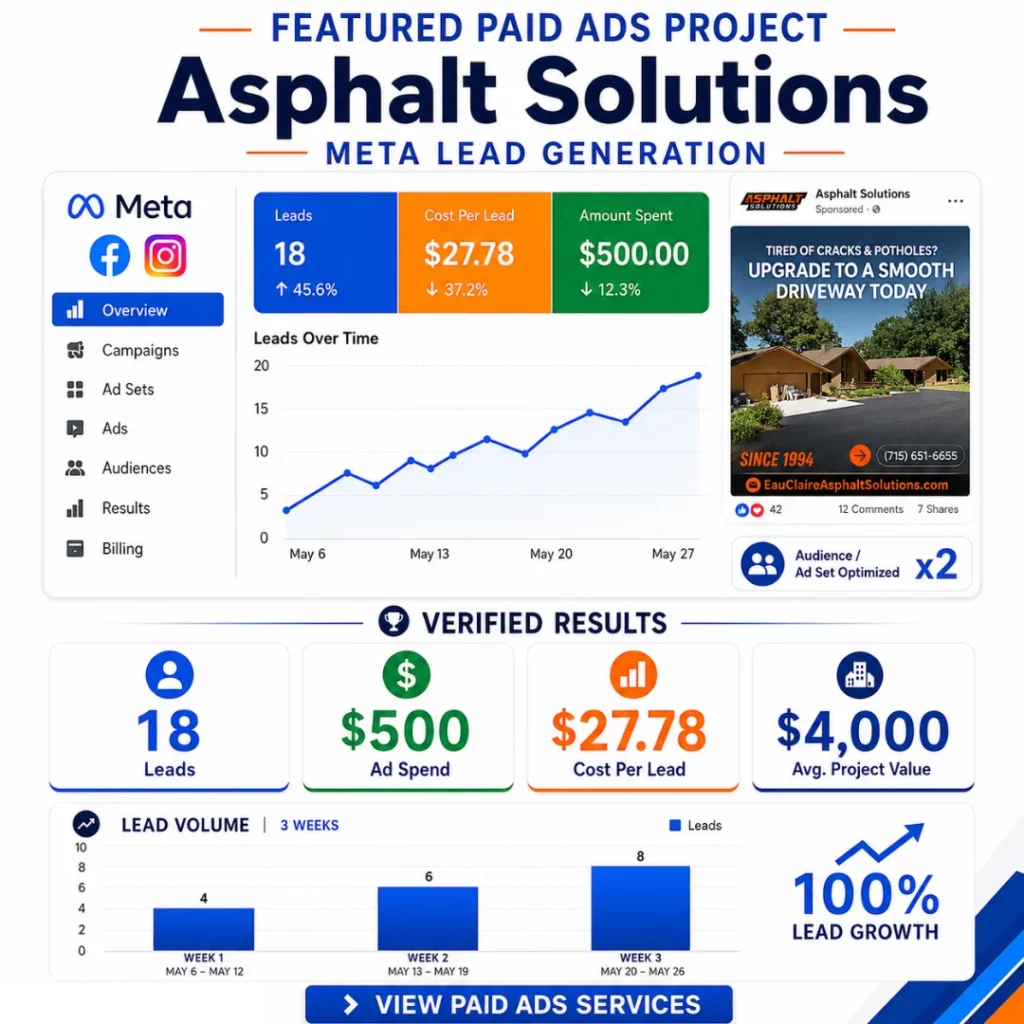
FEATURED PAID ADS PROJECT
Asphalt Solutions
Paving Lead Generation Campaign
THE OBJECTIVE
Generate qualified leads for Asphalt Solutions’ paving services through targeted Facebook and Instagram advertising. The campaign was built to reach prospective customers with paving needs and turn paid social traffic into direct lead opportunities.
WHAT WE CHANGED
We monitored campaign performance closely and restructured the ad groups twice during the three-week campaign to improve targeting and lead-generation efficiency.
Our optimization work focused on refining the audience and campaign structure based on actual performance data rather than allowing the original setup to run unchanged.
THE VERIFIED RESULT
In just 3 weeks, the Meta Ads campaign generated:
18 leads
$500 total ad spend
$27.78 average cost per lead
With Asphalt Solutions’ average service value at approximately $4,000, the campaign generated a meaningful pipeline of potential paving projects from a relatively small advertising budget.
PLATFORM
Meta Ads
CAMPAIGN FOCUS
Lead Generation
MEASURED OUTCOME
18 new Leads in just 3 weeks
PLANNING THE CAMPAIGN
What Determines the Scope and Cost of Paid Ads Management?
Paid advertising has two different financial components: the money paid to the advertising platform and the work required to plan, manage, track, and improve the campaign.
Therefore, businesses should evaluate media budget and agency-management scope separately. Before launch, billing, access, approvals, tracking responsibilities, and reporting expectations should also be clear.
CAMPAIGN FACTOR
MORE FOCUSED SCOPE
ADDS MORE SCOPE
Platform Mix
One focused platform and one clear campaign objective.
Multiple platforms, campaign types, audiences, creative systems, and reporting models.
Geography
A tightly defined local or regional market.
Statewide, national, multi-location, or market-by-market campaign structures.
Creative Requirements
Text ads or a limited set of existing brand assets.
Ongoing image, video, offer, landing-page, and platform-specific creative production.
Conversion Tracking
Existing analytics and clear form or call goals.
New tracking setup, call tracking, CRM integration, offline conversion imports, purchase values, or complex attribution needs.
Landing Pages
Strong existing pages already match the campaign intent.
New landing pages, copywriting, design, testing, form changes, or conversion improvements are required.
Existing Account Condition
A clean new account or organized campaign history.
Takeovers, audits, restructures, tracking problems, policy issues, legacy campaigns, or unclear ownership add review time.
Competition & Budget
A focused market with enough budget to gather useful data.
Highly competitive auctions, broad targeting, expensive clicks, many product groups, or limited budget relative to the market increase complexity.
COMMON PAID ADS QUESTIONS
Questions Businesses Ask Before Hiring a Paid Ads Agency
Paid advertising creates a lot of numbers quickly. However, the most important questions usually concern budget, tracking, account access, expectations, lead quality, and how campaign decisions will be made.
How much should a business spend on paid advertising?
There is no universal starting budget. The right amount depends on the market, platform, geographic reach, click costs, conversion rate, lead value, competition, and how much data the campaign needs to generate before decisions become useful.
For that reason, media spend should be planned separately from agency fees and adjusted using live campaign data rather than a generic percentage.
How quickly can paid ads start generating results?
Paid campaigns can begin serving after setup, approval, eligibility, and platform review. However, that does not guarantee immediate qualified leads, sales, or a profitable return.
Campaigns usually need time to collect data, test messages, identify weak traffic, and improve targeting. In addition, the business sales cycle and follow-up process affect how quickly advertising activity turns into revenue.
Can Madison Media Services guarantee leads or return on ad spend?
No. Paid advertising platforms use auctions and automated systems that are affected by competition, bids, targeting, relevance, landing-page quality, market demand, policy, and many other factors.
Therefore, we focus on the parts that can be managed: planning, targeting, testing, tracking, monitoring, optimization, and reporting.
Can paid ads guarantee the top position on Google?
No. Google Ads placement changes from auction to auction. Ad Rank can be influenced by factors such as bid, predicted usefulness, ad relevance, destination quality, assets, competition, and the context of the search.
As a result, paid search should be managed around business goals rather than a promise of permanent top placement.
What is the difference between ad spend and a management fee?
Ad spend is the budget used by the advertising platform to deliver ads. A management fee covers the agency work required to research, build, monitor, test, report on, and improve the campaign.
Before launch, businesses should confirm exactly how platform billing and agency fees are handled so the two costs are easy to understand.
Can you take over an existing Google Ads account?
Existing accounts can often be reviewed and improved, but the amount of work depends on access, campaign history, tracking quality, current structure, billing, policy status, and the condition of the landing pages.
Therefore, an account takeover may begin with discovery or an audit before a decision is made to preserve, restructure, or rebuild campaigns.
How do you know whether a lead from paid ads is actually good?
A form submission or phone call is only the beginning. When the business can provide reliable follow-up data, lead stages, booked jobs, purchases, signed contracts, or other downstream outcomes can help determine which campaigns create better opportunities.
For example, CRM or offline-conversion data can add context beyond raw conversion volume when the technical setup supports it.
Should we use Google Ads, Facebook and Instagram ads, or both?
The answer depends on how customers buy. Google Search is often useful for active demand, while paid social can support awareness, retargeting, offer promotion, and audience development.
In many cases, one focused channel is the better starting point. Then, after the campaign has useful data and the budget supports expansion, additional platforms can be evaluated.