


EMAIL MARKETING • WISCONSIN
Email Marketing Services for Wisconsin Businesses
Madison Media Services helps businesses plan, write, design, segment, send, and improve email campaigns built around a clear audience, useful message, and next step.
Email can support newsletters, promotions, announcements, follow-up, and automated communication. However, effective campaigns need more than a large list. They need relevant content, thoughtful targeting, mobile-friendly presentation, and a reason for the reader to act.
Serving Since 2008
Campaign Strategy
Writing + Design
Segmentation + Follow-Up
AUDIENCE + MESSAGE + FOLLOW-UP
Email Built Around the Reader’s Next Step
01
Segment
First, organize useful audience groups so campaigns can send more relevant messages when the data supports it.
02
Communicate
Next, give each campaign a clear purpose, useful message, mobile-friendly presentation, and next step.
03
Improve
Finally, review campaign data and workflow results so future sends can be refined instead of repeated blindly.
COPY + DESIGN
SEGMENT + AUTOMATE
WHAT EMAIL MARKETING INCLUDES
What Does Professional Email Marketing Actually Include?
Professional email marketing combines campaign planning, audience targeting, writing, design, calls to action, automation where appropriate, and performance review.
For example, a newsletter, promotion, announcement, and automated follow-up may all use email, but each serves a different purpose. Therefore, the audience, message, timing, and measurement should reflect the specific campaign.
01
Campaign Strategy
Define the goal before writing the email. Choose what the campaign should accomplish, who should receive it, what the reader needs to understand, and which action matters most.
02
Audience Segmentation
Avoid treating every contact the same. Group recipients by useful criteria such as interest, behavior, customer relationship, or another relevant data point supported by the available list.
03
Writing & Design
Turn the strategy into a clear email experience. Develop subject lines, copy, calls to action, and mobile-friendly creative that supports the campaign goal without burying the message.
04
Automation & Reporting
Keep useful communication moving. Where appropriate, automated follow-ups can respond to actions or stages in the customer journey. Reporting then helps guide future campaign decisions.
AN EMAIL BLAST ISN’T A STRATEGY
Sending More Email Doesn’t Automatically Create Better Marketing.
A business can send frequently and still struggle if the list is poorly organized, the message is generic, the design hides the important information, or the reader has no clear next step.
Instead, effective email marketing starts with relevance. The campaign should connect the audience, message, timing, and action before anyone presses send.
RIGHT MESSAGE. RIGHT AUDIENCE. CLEAR NEXT STEP.
01
Know the Goal
Give every campaign a purpose.
A campaign built around one primary objective is easier to write, design, measure, and act on than an email trying to accomplish everything at once.
02
Know the Audience
Make the message more relevant.
Segmentation can help separate customers, prospects, interests, behaviors, or other meaningful groups instead of sending the same message to everyone.
03
Make Action Clear
Show the reader what comes next.
A useful call to action should fit the email’s purpose, whether that means visiting a page, reading more, replying, booking, purchasing, or taking another defined step.
04
Learn From the Send
Use data to improve the next campaign.
Opens, clicks, replies, conversions, unsubscribes, and other available signals can provide context. However, the most useful metrics depend on the campaign goal.
FROM IDEA TO INBOX
Strong Email Campaigns Connect Strategy, Content, Design & Follow-Up.
Email marketing can support many customer journeys. However, the campaign becomes much more useful when the planning, copy, design, targeting, automation, and reporting support the same goal.
01
Campaign Planning
Start with the business objective.
Newsletters, promotions, announcements, educational campaigns, and follow-up sequences should each have a defined audience, purpose, timing, and next step.
02
List Segmentation
Create more useful audience groups.
Segmentation can use relevant customer, interest, or behavior data when that information is available and appropriate for the campaign.
03
Email Copywriting
Make the message easy to understand.
Subject lines, preview text, headlines, body copy, offers, and calls to action should work together rather than compete for attention.
04
Email Design
Build for clarity across screen sizes.
Clean layouts, readable type, purposeful images, obvious buttons, and mobile-friendly formatting help the message remain usable on different devices.
05
Automated Follow-Up
Use triggered communication where it fits.
Welcome emails, follow-ups, reminders, and behavior-based sequences can reduce repetitive manual work when the underlying workflow and data are configured correctly.
06
Campaign Reporting
Review what happened after the send.
Available campaign data can reveal which messages, links, segments, and actions deserve more attention. As a result, future campaigns can be adjusted using evidence instead of assumptions.
MORE
RELEVANT
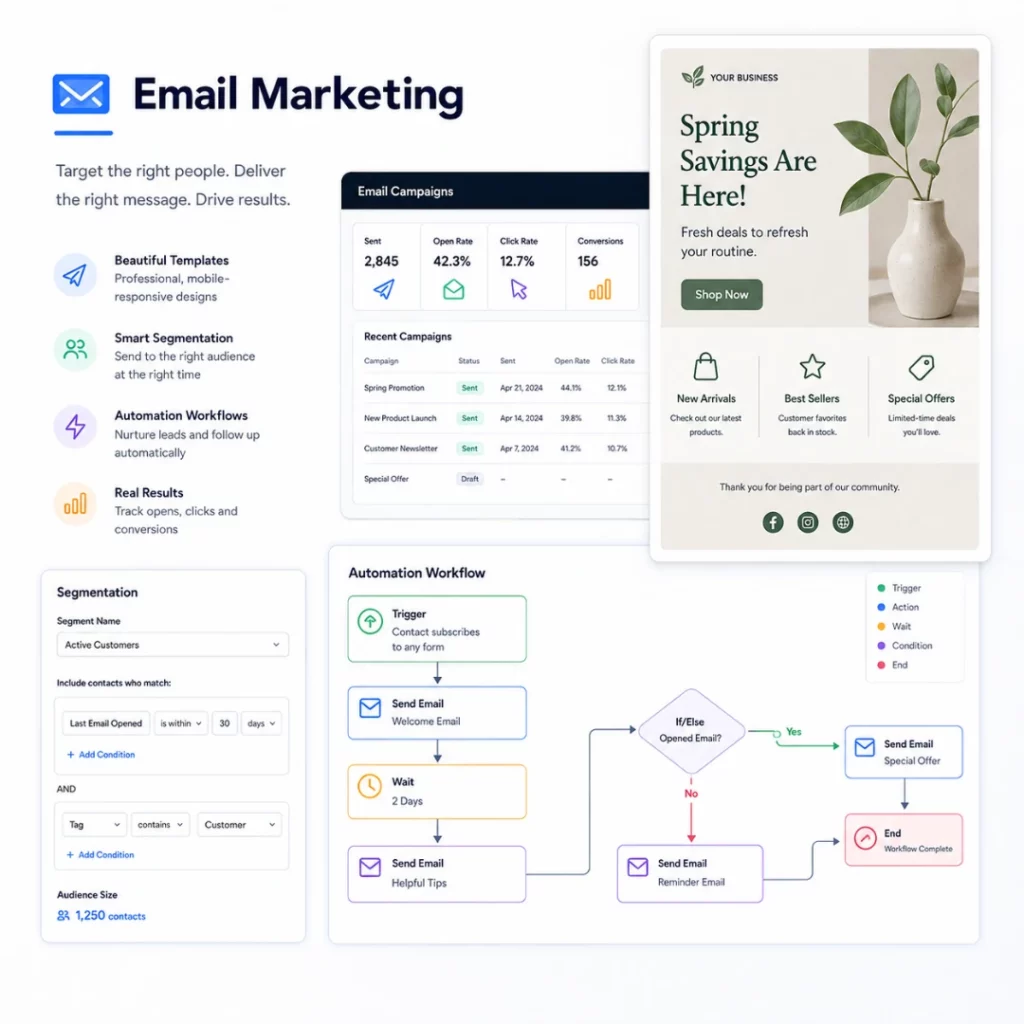
SEGMENTATION + AUTOMATION
The Same Email Does Not Need to Go to Everyone.
A new subscriber, an existing customer, a past customer, and someone who clicked a specific offer may need different information. Segmentation helps organize those differences so campaigns can become more relevant.
Automation can extend that strategy by sending follow-ups based on defined actions or stages. In addition, a connected CRM can help organize contact data and customer history when the business needs a broader follow-up system.
Segment
Organize contacts around useful differences.
Audience groups can support more focused newsletters, promotions, education, reminders, or follow-up.
Automate
Trigger communication when the workflow calls for it.
Welcome sequences, reminders, and follow-up can reduce repetitive manual sending when the system is configured correctly.
Measure
Compare campaign behavior with the original goal.
The important question is not whether every metric went up. It is whether the campaign created useful movement toward the intended action.
HOW EMAIL CAMPAIGNS COME TOGETHER
From Campaign Goal to Performance Review
A repeatable email process makes each campaign easier to plan and easier to evaluate. First, define the audience and purpose. Then build, test, send, measure, and use what was learned.
01
Define the Goal
Decide what the campaign needs to accomplish.
We identify the primary purpose, audience, offer or information, desired reader action, sending context, and how the campaign will be evaluated.
02
Review the Audience
Understand who should receive the message.
Next, we review the available contact data and identify useful audience segments. List source, permissions, data quality, and sending requirements should also be addressed before launch.
03
Plan the Message
Build the campaign around one clear idea.
Subject line direction, content hierarchy, offer, supporting information, links, and call to action are planned before the final email is produced.
04
Write & Design
Turn the plan into an inbox-ready experience.
Copy and creative are developed with attention to clarity, brand voice, mobile readability, visual hierarchy, and the action the reader should take.
05
Review & Test
Check the campaign before sending.
Links, personalization, formatting, mobile behavior, audience selection, automation rules, and other campaign settings should be reviewed before the message goes live.
06
Send or Automate
Launch the approved communication.
The campaign is sent to the intended audience or placed into the agreed automated workflow. Timing and frequency should reflect the campaign purpose rather than a fixed quota.
07
Measure & Improve
Use campaign results to plan the next move.
Finally, available performance data and business outcomes are reviewed. Then future subject lines, content, segments, timing, and calls to action can be refined.
WHAT BETTER EMAIL MARKETING SHOULD SUPPORT
What Should a Better Email Marketing Program Improve?
Email marketing cannot guarantee opens, clicks, leads, purchases, or a specific return. Results depend on the list, offer, audience, message, timing, deliverability, customer demand, and many other factors.
Instead, a stronger program should improve the communication process the business can control: relevance, consistency, clarity, follow-up, and the information used to make future campaign decisions.
01
Relevance
Send messages that better match the audience.
Segmentation and campaign planning can reduce generic messaging by connecting the email to a more specific recipient group or customer situation.
02
Consistency
Create a repeatable communication rhythm.
Newsletters, announcements, promotions, and automated follow-ups become easier to manage when the process does not restart from zero every time.
03
Clarity
Make the campaign’s purpose easier to understand.
Focused subject lines, readable copy, mobile-friendly design, and a clear call to action help readers quickly understand why the email matters.
04
Follow-Up
Support customer communication beyond the first touch.
Automated sequences and planned campaigns can create useful follow-up opportunities after signups, purchases, inquiries, clicks, or other defined stages.
05
Insight
Use campaign data to improve future communication.
Reporting can show how recipients interacted with different messages and links. Consequently, future campaigns can be adjusted using actual behavior rather than guesses.
REAL CAMPAIGNS. REAL CONTEXT.
Email Marketing Proof Should Connect the Message to the Outcome.
A useful email case study explains the audience, goal, campaign, and measurable outcome within a defined period.
Therefore, replace the placeholders below with an approved MMS campaign rather than relying on generic industry ROI statistics or an isolated open-rate screenshot.
FEATURED EMAIL CAMPAIGN
Picketts Paving / Commercial Paving
THE CAMPAIGN GOAL
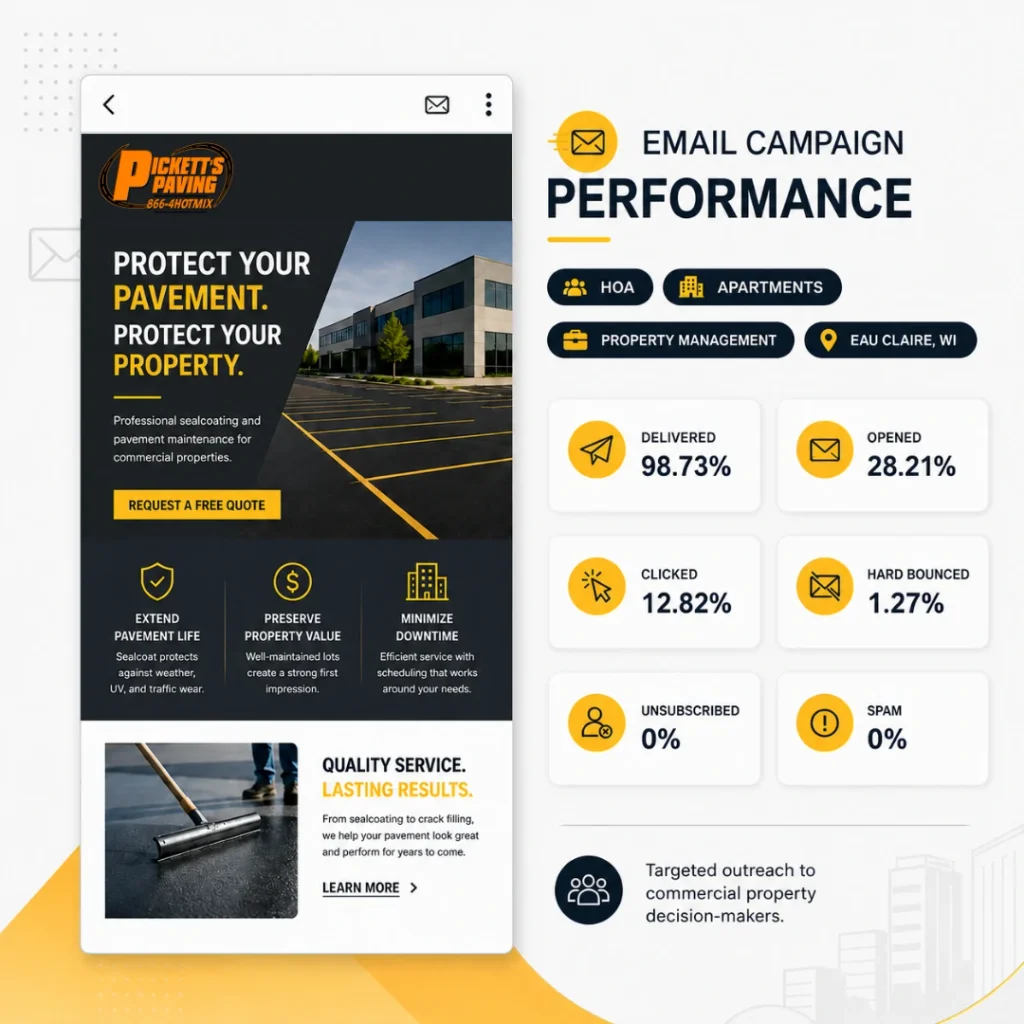
Reach HOAs, apartment communities, and property management companies in Eau Claire, Wisconsin with a targeted email campaign promoting asphalt maintenance and sealcoating services.
The campaign was designed to put the service in front of commercial property decision-makers who are responsible for protecting pavement, maintaining curb appeal, and planning preventative property maintenance.
WHAT WE CREATED
Madison Media Services developed a targeted email campaign built around the value of preventative asphalt maintenance.
The creative focused on the message “Seal Today. Save Tomorrow.” and positioned sealcoating as a way to protect pavement, extend its useful life, and maintain the appearance of the property. The email included:
- A visually branded promotional design
- Service-focused copy centered on pavement protection and property value
- A clear “Get a Free Estimate” call to action
- A QR code providing an additional response path
- Targeting focused on HOAs, apartments, and property management audiences in the Eau Claire market
THE VERIFIED RESULT
The campaign reporting showed:
98.73% delivered
28.21% opened
12.82% clicked
0% unsubscribed
0% spam complaints
1.27% hard bounced
The campaign produced a 12.82% reported click rate, showing measurable engagement with the email and its call to action.
CAMPAIGN TYPE
[Automation]
WORK INCLUDED
[Strategy • Copy • Design • Segmentation]
MEASURED OUTCOME
98.73% delivered
28.21% opened
12.82% clicked
0% unsubscribed
0% spam complaints
1.27% hard bounced
PLANNING YOUR EMAIL MARKETING SCOPE
What Determines the Cost of Email Marketing?
Email marketing scope can change significantly based on campaign frequency, audience complexity, content production, automation, data quality, integrations, and reporting needs.
For example, a monthly newsletter built from an established template is very different from a multi-step automated sequence connected to a CRM or e-commerce system.
SCOPE FACTOR
MORE FOCUSED SCOPE
ADDS MORE SCOPE
Campaign Frequency
A focused plan sends occasional newsletters, announcements, or promotions.
More frequent campaigns increase planning, writing, design, approval, testing, and reporting needs.
Audience Segmentation
The list uses one or a few straightforward audience groups.
Multiple segments, behavioral groups, lifecycle stages, or complex personalization increase data and campaign-management requirements.
Copy & Creative
A campaign uses a consistent template and straightforward message.
Custom layouts, multiple creative variations, extensive copy, new graphics, or ongoing asset production add scope.
Automation Complexity
A campaign is scheduled as a one-time send or simple recurring message.
Multi-step welcome, nurture, reminder, re-engagement, or behavior-based workflows require more setup, logic, testing, and maintenance.
List & Data Condition
Contact data is organized, current, and ready for the intended campaign.
Duplicate records, unclear permissions, inconsistent fields, migration needs, or poor data quality can require cleanup before useful segmentation is possible.
Integrations
The email platform works largely on its own.
CRM, e-commerce, forms, scheduling, analytics, sales pipelines, and other integrations can add configuration and testing.
Reporting & Optimization
A concise campaign review covers agreed performance indicators.
Custom dashboards, attribution work, deeper segmentation analysis, repeated testing, or frequent strategy reviews increase reporting scope.
COMMON EMAIL MARKETING QUESTIONS
Questions Businesses Ask Before Starting Email Marketing
Email campaigns involve practical decisions about audiences, content, sending frequency, automation, list quality, design, and measurement. These answers cover the issues that should be clear before a campaign launches.
What types of email campaigns can businesses send?
Common campaign types include newsletters, promotions, company announcements, educational emails, welcome messages, reminders, and automated follow-up sequences.
However, the right mix depends on the business, audience, available contact data, and customer journey.
Can Madison Media Services help write and design the emails?
Yes. The current Madison Media Services email-marketing page describes support from strategy through writing and design. Campaign copy, calls to action, and mobile-friendly presentation can therefore be planned as part of the overall email experience.
Exact production volume and revision scope should still be defined in the service plan.
What is email segmentation?
Segmentation divides a contact list into useful groups so the same email does not have to go to everyone. A business might separate audiences by interest, behavior, customer relationship, purchase history, or another relevant data point.
Better segmentation can make the message more specific. However, it depends on having appropriate and reliable data.
What is email marketing automation?
Email automation sends messages based on defined timing, actions, or customer stages instead of requiring every follow-up to be sent manually.
For example, businesses may use welcome emails, reminders, follow-up sequences, or other triggered communication when the workflow and data support it.
How often should a business send marketing emails?
There is no universal sending frequency. The right cadence depends on the audience, business model, campaign type, amount of useful content, customer expectations, and list response.
Therefore, frequency should be planned around relevance rather than simply sending more often.
Can email marketing guarantee sales or a specific ROI?
No. Email results depend on the list, audience, offer, message, timing, deliverability, customer demand, website experience, and many other factors.
Instead, campaigns should be measured against the goal they were created to support, using the most relevant available performance and conversion data.
Can I use any email list for a campaign?
List source and permission status matter. In addition, unsubscribe handling, sender information, platform rules, and applicable legal requirements can affect whether and how a campaign should be sent.
Before launch, the business and service provider should clearly establish the list source, sending responsibilities, and requirements that apply to the campaign.
How does email marketing work with a CRM?
Email marketing can operate independently, but a CRM can add customer history, pipeline stages, contact fields, and workflow data that support more organized segmentation and follow-up.
If the business needs broader lead management and automation, our CRM Solutions page explains that system in more detail.
LET’S BUILD WHAT’S NEXT
Ready to Grow Your Business Online?
Let’s build a smarter digital strategy designed to increase your visibility, generate more leads, and help your business grow.