


SOCIAL MEDIA MANAGEMENT • WISCONSIN
Social Media Management for Wisconsin Businesses
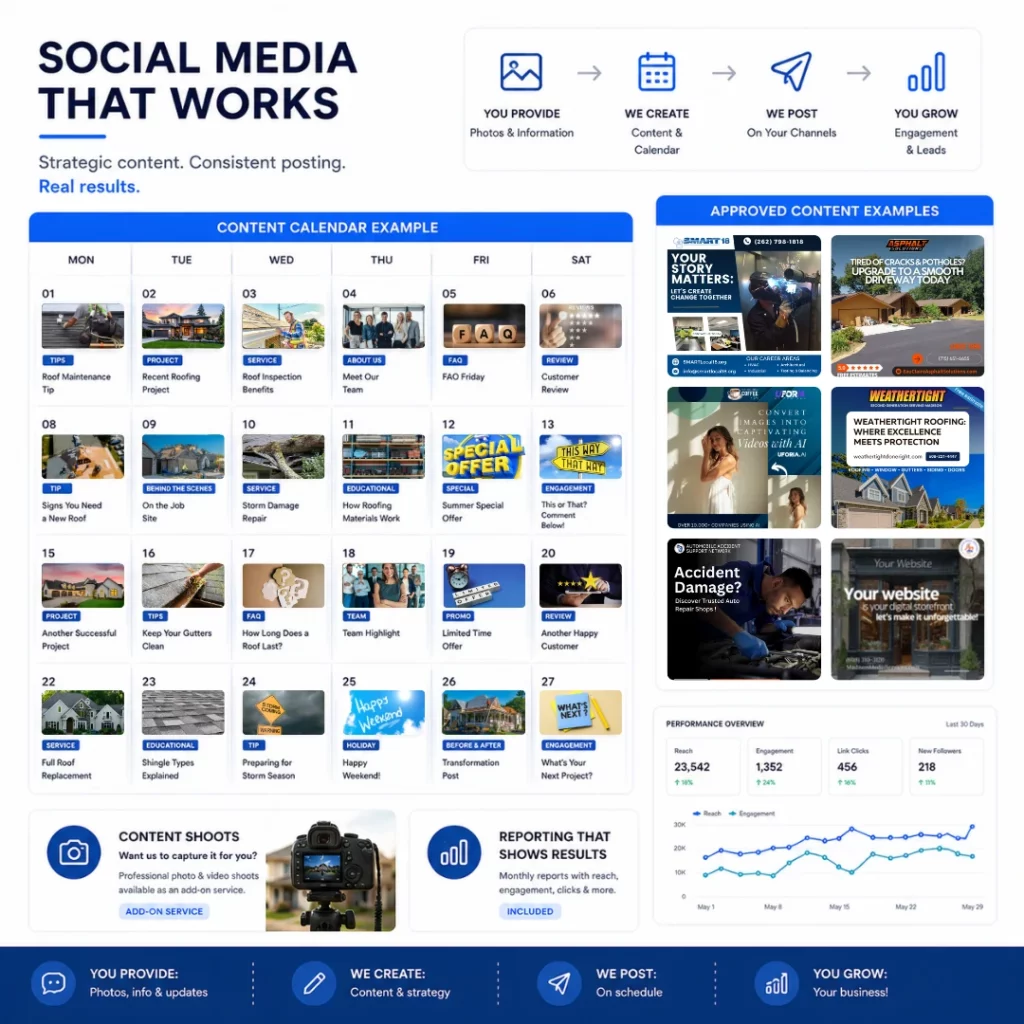
Madison Media Services helps businesses plan, create, schedule, and manage social media content with a consistent brand voice and a clearer monthly strategy.
Instead of guessing what to post each week, your business gets a repeatable process for content planning, creative production, publishing, engagement, and reporting. As a result, social media becomes easier to manage and easier to evaluate.
Serving Since 2008
Custom Social Strategy
Content + Scheduling
Monthly Reporting
STRATEGY + CONTENT + MANAGEMENT
A Clearer System for Staying Active on Social Media
01
Plan
First, build topics around the brand, audience, business priorities, goals, and publishing calendar.
02
Create
Next, develop captions and supporting creative that fit the business and the selected social platforms.
03
Review
Finally, use reporting, approvals, and feedback to guide the next content cycle instead of starting from scratch.
CONTENT + POSTING
VOICE + STRATEGY
CONSISTENCY NEEDS A SYSTEM
Social Media Gets Hard When Every Post Starts From Zero.
For many businesses, the challenge is not understanding that social media matters. The challenge is finding time to plan topics, gather assets, write copy, publish consistently, respond appropriately, and then decide what to do next.
However, more posting is not automatically better. A clearer system can reduce the weekly scramble while keeping the content tied to actual business priorities.
PLAN IT. CREATE IT. KEEP IT MOVING.
01
Stay Consistent
Replace last-minute posting with a repeatable plan.
A content calendar and defined workflow make it easier to keep social activity moving even when the owner’s schedule gets busy.
02
Stay On-Brand
Keep messaging and creative connected to the business.
Brand voice, visual direction, approvals, and recurring content themes help each post feel like part of one recognizable business presence.
03
Stay Relevant
Create content around real business priorities.
Instead of posting only because the calendar is empty, content can support services, education, seasonal needs, company updates, proof, and customer questions.
04
Stay Accountable
Review what happened and adjust the next cycle.
Monthly reporting, platform observations, client feedback, and business priorities provide a more useful basis for future planning than follower counts alone.
MANAGED SOCIAL MEDIA SUPPORT
Strategy and Creative Execution Should Work Together.
A social media plan is easier to maintain when strategy, content production, publishing, engagement rules, approvals, and reporting are part of the same workflow.
In addition, clear responsibilities help prevent content from stalling between the agency and the client.

01
Social Media Strategy
Give the content a reason to exist.
We connect social topics to the brand, audience, services, customer questions, seasonal opportunities, business priorities, and realistic production capacity.
02
Content Calendar Planning
Know what is coming before publishing day.
A recurring calendar creates visibility into upcoming topics, creative needs, approvals, and timing. As a result, the team has more time to prepare useful content.
03
Caption & Creative Development
Turn ideas into publishable content.
Copy, graphics, photos, video, hashtags, and other creative elements can be developed according to the approved scope and the assets available from the business.
04
Posting & Scheduling
Keep approved content moving on schedule.
Once content is reviewed, posts can be prepared and scheduled across the selected platforms. Therefore, publishing does not depend on someone remembering at the last minute.
05
Community Management Support
Create rules for how the brand responds.
Where included, engagement support can address public comments, messages, approvals, escalation, sensitive topics, and client responsibilities through a defined workflow.
06
Performance Reporting & Strategy Updates
Use the last cycle to improve the next one.
Reporting can review relevant platform metrics, content performance, audience response, and business context. Then the next content cycle can be adjusted based on what was learned.
ONE
VOICE
ORGANIC SOCIAL ≠ PAID SOCIAL
Social Media Management and Paid Advertising Solve Different Problems.
Organic social media management focuses on the ongoing brand presence: strategy, content, publishing, engagement, and reporting. Paid social advertising, by contrast, uses advertising budgets, audience targeting, campaign objectives, bidding, creative testing, and conversion tracking.
Both can support the same business. However, they should not be presented as the same service. Therefore, we keep managed social content separate from Paid Ads management so the scope, budget, and measurement remain clear.
Organic Strategy
Build the ongoing brand presence.
Plan recurring topics, create content, publish consistently, and maintain an agreed engagement process.
Paid Campaigns
Purchase targeted distribution.
Use campaign budgets, targeting, ads, testing, landing pages, and conversion tracking to pursue specific paid-media objectives.
Shared Brand
Keep both channels recognizable.
Even when the goals differ, messaging, creative direction, offers, and customer experience should still feel connected to the same business.
HOW MANAGED SOCIAL MEDIA WORKS
From Brand Discovery to the Next Content Cycle
A useful social media process should reduce uncertainty. First, the team agrees on the brand, goals, responsibilities, and content plan. Then content moves through creation, approval, publishing, engagement, and reporting.
01
Discover
Understand the brand before creating content.
We review the business, audiences, services, existing profiles, brand voice, visual assets, current posting habits, goals, competitors, internal resources, and approval needs.
02
Plan
Define the content system and responsibilities.
Next, we establish priorities, selected platforms, content themes, cadence, formats, asset needs, approval roles, and any community-management responsibilities included in the plan.
03
Build the Calendar
Turn the strategy into upcoming topics.
A content calendar organizes the next publishing cycle around business priorities, seasonal opportunities, educational topics, proof, company updates, and other approved themes.
04
Create
Develop the copy and visual content.
Captions and creative are produced using approved brand direction and available assets. When photography or video is part of the project, those production requirements should also be planned in advance.
05
Approve & Schedule
Move finished content into the publishing workflow.
Content is reviewed according to the agreed approval process. After approval, posts can be scheduled or prepared for publishing across the selected platforms.
06
Engage
Follow the agreed response and escalation process.
Where community management is included, public comments or messages are handled according to defined response rules, approvals, privacy considerations, and escalation responsibilities.
07
Report & Adjust
Use performance and feedback to guide the next cycle.
Finally, reporting reviews relevant metrics and observations. Then the next calendar can be refined based on content performance, audience response, business changes, and client feedback.
WHAT MANAGED SOCIAL SHOULD SUPPORT
What Should Better Social Media Management Actually Improve?
No agency can guarantee follower growth, engagement, virality, leads, or sales from organic social media. Those outcomes depend on the audience, content, platform behavior, competition, offer, budget, and many other factors.
Instead, a managed program should improve the process the business can control: consistency, brand clarity, content quality, workflow, and the information used to make future decisions.
01
Consistency
Maintain a more dependable publishing rhythm.
A calendar, production workflow, and clear responsibilities can make it easier to stay active without relying on last-minute ideas.
02
Brand Clarity
Make social content feel like it belongs to the business.
Repeated voice, visual direction, content themes, and approval standards help customers encounter a more recognizable brand across posts.
03
Time Savings
Move recurring social work off the owner’s weekly task list.
When planning, copy, creative, scheduling, and reporting are organized in one workflow, internal teams can spend less time rebuilding the process each week.
04
Audience Connection
Create more opportunities for useful interaction.
Relevant content and an agreed engagement process can support customer questions, comments, updates, education, community participation, and brand familiarity.
05
Better Decisions
Use reporting to improve future planning.
Performance data does not guarantee future outcomes. However, it can show which topics, formats, and messages deserve more attention in the next content cycle.
SHOW THE WORK
A Social Media Case Study Should Show More Than Follower Counts.
Useful proof explains the starting challenge, the content system that was created, the work completed, and what changed during a defined period.
Therefore, this section should use a real MMS project with client permission rather than a fabricated analytics screen or an isolated vanity metric.
FEATURED SOCIAL MEDIA PROJECT
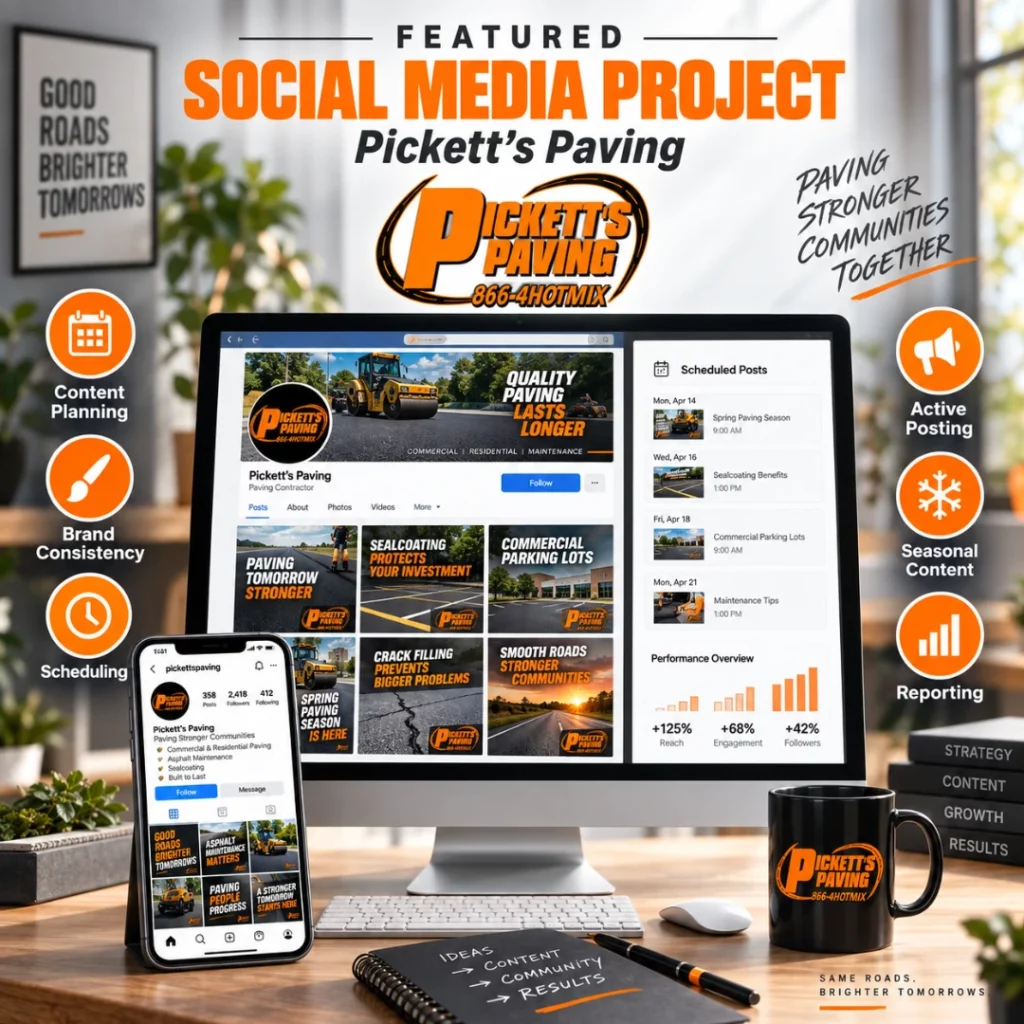
Pickett’s Paving — Ongoing Social Media Management
THE CHALLENGE
Pickett’s Paving needed a more consistent and professional social media presence. Posting had been irregular, and the visual presentation of the brand was not always consistent from one piece of content to the next.
The challenge was to create a recognizable look and communication style while keeping the company active online with relevant content throughout the paving season. The social presence also needed to better reflect the quality and professionalism of the business across Facebook and Instagram.
WHAT WE CHANGED
Madison Media Services developed an ongoing social media management process for Pickett’s Paving built around consistency, brand alignment, and useful service-focused content.
Our work includes monthly content planning, branded graphic design, caption writing, scheduling and publishing, review and promotional content, seasonal messaging, educational posts, project and service highlights, and ongoing adjustments to keep the content relevant to the company’s services and audience.
We also established a more consistent visual system for colors, typography, imagery, layouts, and messaging so individual posts feel connected to the same Pickett’s Paving brand rather than appearing as unrelated pieces of content.
THE VERIFIED RESULT
Pickett’s Paving now has a structured social media workflow that keeps its Facebook and Instagram presence active with consistent, professionally branded content.
The company has an established visual direction and recurring content process that can support paving services, commercial projects, asphalt maintenance, promotions, customer education, and seasonal messaging without relying on sporadic posting.
INCONSISTENT POSTING → PLANNED CONTENT + CONSISTENT BRANDING + ACTIVE SOCIAL PRESENCE
BUSINESS TYPE
Paving in Madison WI
WORK INCLUDED
Strategy • Content • Posting • Reporting
MEASURED OUTCOME
INCONSISTENT POSTING → PLANNED CONTENT + CONSISTENT BRANDING + ACTIVE SOCIAL PRESENCE
PLANNING YOUR SOCIAL MEDIA SCOPE
What Determines the Cost of Social Media Management?
Social media management cost depends on the amount of strategy, content, creative production, publishing, engagement, coordination, and reporting required each month.
For example, a focused plan using existing photos and a modest posting schedule requires a different production system than a multi-platform program with frequent video, community management, and custom reporting.
SCOPE FACTOR
MORE FOCUSED SCOPE
ADDS MORE SCOPE
Number of Platforms
A focused plan manages a limited set of priority social channels.
Adding more platforms increases planning, formatting, publishing, access, monitoring, and reporting requirements.
Posting Cadence
A lower posting frequency requires fewer monthly content pieces.
A higher posting frequency increases writing, creative production, approvals, scheduling, and asset needs.
Content Formats
Static posts and straightforward brand graphics keep production more focused.
Reels, short-form video, stories, animation, carousels, photography, and custom production can add significant scope.
Photo & Video Assets
The business already has usable, rights-cleared photos and video.
On-location photography, video capture, editing, scripting, or ongoing asset production requires additional planning and production.
Community Management
The service focuses primarily on strategy, content, and publishing.
Public comment responses, private messages, after-hours needs, escalation, and sensitive-topic workflows add ongoing management responsibilities.
Approval & Revision Process
One clear decision-maker reviews content on an agreed schedule.
Multiple reviewers, extensive revisions, compliance checks, or slow approval cycles can increase project coordination.
Reporting & Strategy
A concise monthly review covers agreed metrics and next steps.
Custom dashboards, deeper analysis, frequent meetings, multiple brands, or location-level reporting can increase reporting scope.
COMMON SOCIAL MEDIA QUESTIONS
Questions Businesses Ask Before Outsourcing Social Media
Outsourcing social media creates practical questions about content, approvals, platforms, engagement, reporting, and responsibilities. These answers clarify the major decisions that should be made before a plan begins.
What is included in social media management?
Social media management can include strategy, content planning, caption writing, creative development, posting, scheduling, community-management support, reporting, and ongoing strategy updates.
However, exact inclusions should be defined in the plan. Platform count, posting frequency, video, photography, revisions, engagement, and reporting depth can all change the scope.
Which social media platforms can you manage?
The right platform mix depends on the business, audience, goals, content resources, and service plan. Madison Media Services has referenced support across major social platforms, but not every platform should be assumed to be included in every plan.
Therefore, the selected channels and access requirements should be confirmed during planning.
How often should a business post on social media?
There is no universal posting frequency that fits every business. The right cadence depends on the platform, audience, content quality, available assets, internal approval speed, and the amount of useful information the business can consistently support.
In many cases, a sustainable schedule is more valuable than an aggressive schedule that produces rushed or repetitive content.
Do you create the photos and videos for social media?
Content production can use existing business assets, newly created graphics, approved photos, video, or a combination. However, photography and video production can add significant project scope.
For that reason, the plan should clearly identify who supplies assets, what formats are included, and whether on-location production is required.
Do you respond to comments and private messages?
Community management can be included, but the exact responsibilities need to be defined. Public comments, private messages, response hours, approvals, privacy concerns, sensitive situations, and escalation rules can require different workflows.
As a result, businesses should agree on what the agency handles and what remains with the internal team.
Is social media management the same as Facebook or Instagram advertising?
No. Organic social media management focuses on the ongoing content and brand presence. Paid social advertising uses ad budgets, audience targeting, campaign objectives, bidding, creative testing, and conversion tracking.
If your primary need is advertising, review our Paid Ads services so the campaign scope and media budget remain separate from organic content management.
Can you guarantee more followers, engagement, or leads?
No. Social media results depend on the audience, platform, content, offer, competition, budget, business reputation, and many other factors outside an agency’s control.
Instead, we focus on the work that can be managed directly: strategy, content quality, consistency, publishing, engagement workflow, and reporting.
How do you measure social media performance?
Useful reporting depends on the goals of the account. For example, businesses may review reach, engagement, content interactions, profile activity, website visits, inquiries, audience trends, or other platform data.
However, not every metric represents business value. Therefore, reporting should connect platform activity to the goals and limitations agreed on at the start.
WHAT SOCIAL MEDIA MANAGEMENT INCLUDES
What Does Professional Social Media Management Actually Do?
Social media management creates a repeatable system for deciding what to publish, producing the content, scheduling posts, managing agreed engagement tasks, and reviewing performance.
In addition, a managed program helps keep the brand voice, visual direction, approvals, and monthly priorities connected. Therefore, the business is not rebuilding its social strategy from scratch every week.
01
Strategy & Content Planning
Define content themes, business priorities, audience needs, brand voice, seasonal opportunities, and an achievable publishing plan.
02
Content Creation
Create social captions and supporting creative based on the agreed plan, available brand assets, and the formats included in the service scope.
03
Posting & Scheduling
Prepare approved content for publishing across the selected social platforms so the business can maintain a more consistent schedule.
04
Engagement & Reporting
Support the agreed community-management workflow and review monthly performance so future content decisions are based on more than guesswork.